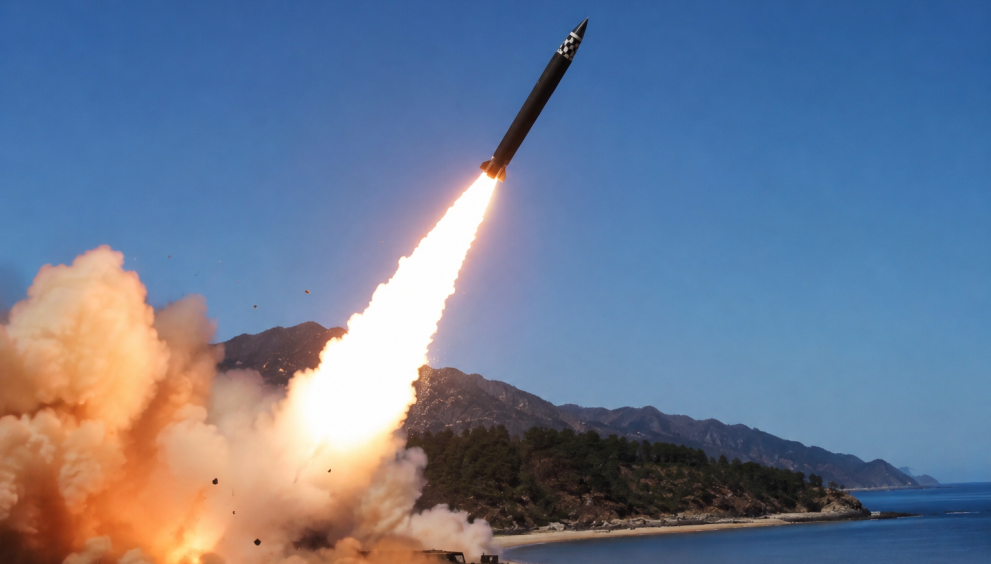
Launch from Wonsan comes days before Ulchi Freedom Shield exercises begin
North Korea fired a ballistic missile into waters off its east coast on Wednesday, sharply raising tensions on the Korean Peninsula just days before South Korea and the United States begin their annual Ulchi Freedom Shield military exercises.
South Korea’s military said the missile was launched from the eastern coastal city of Wonsan and flew approximately 700 kilometers (435 miles) before landing in the Sea of Japan (East Sea). The launch was detected and tracked by South Korean and U.S. surveillance systems, with both militaries confirming the projectile did not pose an immediate threat to their territories.
Possible advanced missile system under analysis
Officials in Seoul have not yet confirmed the exact type of missile fired, but military analysts cited by international media suggest the trajectory and flight distance are consistent with either a short-range ballistic missile (SRBM) or a newer hypersonic-capable system under development by Pyongyang.
Some experts also noted the possibility that the launch could be linked to submarine-launched ballistic missile (SLBM) technology testing from land-based platforms, a method North Korea has used in past experimental trials to simulate underwater launch conditions.
The missile test marks North Korea’s 11th known or suspected launch in 2026, and comes just days after another reported failed or partial test on Aug. 6, also conducted near the country’s eastern coastline.
South Korea calls launch “provocation”
South Korea’s Joint Chiefs of Staff (JCS) condemned the missile firing, calling it a “clear act of provocation” that undermines regional stability and violates multiple U.N. Security Council resolutions prohibiting North Korea from conducting ballistic missile tests.
The JCS said South Korean forces, in coordination with the U.S. Indo-Pacific Command, have increased surveillance and readiness levels in response to the launch. Military officials also confirmed that no damage or casualties were reported.
Japan’s Defense Ministry separately confirmed the missile did not enter Japanese territory or its exclusive economic zone (EEZ), but described the launch as a serious security concern and lodged a formal diplomatic protest through North Korean channels.
U.S. response and regional security concerns
The U.S. Indo-Pacific Command said the missile launch did not pose an immediate threat to the United States or its allies but reaffirmed Washington’s “ironclad commitment” to the defense of South Korea and Japan.
U.S. officials emphasized that the launch underscores the importance of continued joint military preparedness, particularly as the Ulchi Freedom Shield exercises approach.
The annual drills, scheduled for Aug. 17–27, will involve approximately 18,000 South Korean troops alongside U.S. forces. The exercises are expected to include simulations of cyber warfare, drone attacks, GPS jamming, and missile defense operations, reflecting what military planners describe as North Korea’s evolving hybrid warfare capabilities.
North Korea’s likely motive
Analysts say the timing of the launch is unlikely to be coincidental. North Korea has consistently condemned U.S.–South Korea joint exercises as “rehearsals for invasion”, often responding with missile tests or military demonstrations in the days leading up to or during the drills.
In recent months, Pyongyang has intensified its rhetoric, warning that the expanding military cooperation between Seoul, Washington, and Tokyo is pushing the region toward a new Cold War-style security confrontation.
State media in North Korea has also accused the United States of escalating tensions by deploying strategic assets in the region, including nuclear-capable bombers and submarines during joint exercises.
Escalating missile program
Since the breakdown of nuclear diplomacy with Washington in 2019, North Korean leader Kim Jong Un has significantly accelerated the country’s weapons development program.
The regime has tested a growing range of systems, including solid-fuel ballistic missiles, hypersonic glide vehicles, and intercontinental ballistic missiles (ICBMs) designed to reach the U.S. mainland. In parallel, North Korea has declared itself a “permanent nuclear weapons state” under its revised constitution.
Security analysts warn that repeated missile launches serve multiple purposes: demonstrating technological progress, testing operational readiness, and strengthening North Korea’s bargaining position in any future negotiations.
Regional reaction and outlook
The latest launch has prompted renewed concern across Northeast Asia, with South Korea, Japan, and the United States closely monitoring for additional provocations ahead of the upcoming military exercises.
While no emergency meetings of the U.N. Security Council have yet been announced, diplomats say the situation remains fluid and could escalate if North Korea continues testing during the exercise period.
For now, military officials in Seoul say preparations for Ulchi Freedom Shield will proceed as scheduled, with enhanced defensive measures in place to counter any further missile activity.