Teodoro Reads Chinese Military Attaché’s Note Aloud and Accuses Beijing of “Coercion, Bullying and Aggression”
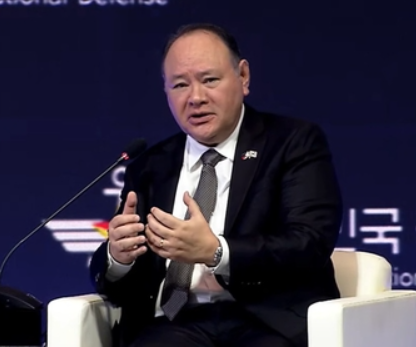
A defence forum in Seoul turned into an unusually public confrontation between the Philippines and China after Philippine Defence Secretary Gilberto Teodoro Jr. received and read aloud a note challenging the 2016 international ruling on the South China Sea.
Teodoro was speaking at the Seoul Defense Dialogue on Tuesday when a forum staff member handed him a note from the audience. The message was later identified by organisers as having been sent by a Chinese military attaché at the Chinese Embassy in Seoul.
Rather than setting the note aside, Teodoro read its contents to the audience before responding directly to Beijing’s position.
CHINA REPEATS REJECTION OF 2016 RULING
The note restated China’s longstanding rejection of the 2016 Permanent Court of Arbitration ruling on the South China Sea.
Beijing maintains that the arbitration was illegal, “null and void” and has no binding force, and says it neither accepts nor recognises the award. The Chinese position also maintains that Beijing will continue to safeguard what it considers its sovereignty and maritime rights while pursuing disputes through dialogue and consultation.
The 2016 tribunal ruling, issued under the United Nations Convention on the Law of the Sea, rejected China’s expansive “nine-dash line” claims to historic rights over much of the South China Sea and upheld aspects of the Philippines’ maritime rights.
China has consistently refused to recognise the ruling.
TEODORO DELIVERS SHARP RESPONSE
Teodoro challenged the note point by point.
When the message argued that the arbitration violated fundamental principles of international law, the Philippine defence chief questioned whether China was therefore suggesting that the United Nations Convention on the Law of the Sea UNCLOS itself violates international law.
When the note said the tribunal’s award had no binding force, Teodoro responded that China rejected it because it did not want to be subjected to UNCLOS.
He then delivered one of the sharpest moments of the exchange, saying of China’s refusal to recognise the ruling: “Of course, because you lost.”
“ACTUAL COERCION, BULLYING AND AGGRESSION”
Teodoro went beyond the legal dispute, questioning the manner in which the message had been delivered.
He accused China of showing a lack of “basic decency” and said the incident demonstrated what he described as “actual coercion, bullying and aggression.”
He also said he would keep the paper as a reminder of what he called China’s “desperate” and “ineffective” position.
The exchange drew applause from members of the audience.
SOUTH CHINA SEA TENSIONS REMAIN HIGH
The confrontation comes as Manila and Beijing continue to face tensions over disputed waters in the South China Sea.
The Philippines has repeatedly accused Chinese vessels of using coercive tactics against Philippine ships operating in areas Manila considers part of its maritime rights. China rejects those accusations and maintains its own extensive territorial and maritime claims.
The dispute has become a major driver of the Philippines’ expanding defence cooperation with the United States and other regional partners.
Speaking to Reuters on the sidelines of the Seoul Defense Dialogue, Teodoro said China could seek to exploit perceived gaps in U.S. military engagement in the Indo-Pacific. He said Washington had nevertheless given Manila assurances that its commitments under the U.S.-Philippines Mutual Defense Treaty remained unchanged.
MANILA DEEPENS REGIONAL DEFENCE TIES
Teodoro’s appearance in Seoul also highlighted the Philippines’ efforts to strengthen defence partnerships beyond its alliance with Washington.
South Korea is an important defence supplier to Manila, providing FA-50 aircraft, frigates and other military equipment as the Philippines modernises its armed forces.
Teodoro said Manila was interested in deeper cooperation with South Korea in defence technology and industrial development, although a long-discussed Philippine submarine programme remains under review.
The Philippines has also expanded security cooperation with countries including Canada, New Zealand, France and Britain.
A DIPLOMATIC CLASH WITH WIDER IMPLICATIONS
What began as an audience message at a multilateral defence forum quickly became a public demonstration of the depth of disagreement between Manila and Beijing.
The episode underscores how the 2016 South China Sea arbitration ruling remains a central fault line in the dispute.
For the Philippines, the ruling remains an important legal foundation for its maritime claims. For China, the decision remains rejected a position Beijing continues to defend even as regional governments push for dialogue and greater stability.
With military and diplomatic tensions continuing across the South China Sea, the unusually public exchange in Seoul offers another indication of just how difficult it remains for the two sides to reconcile their competing positions.