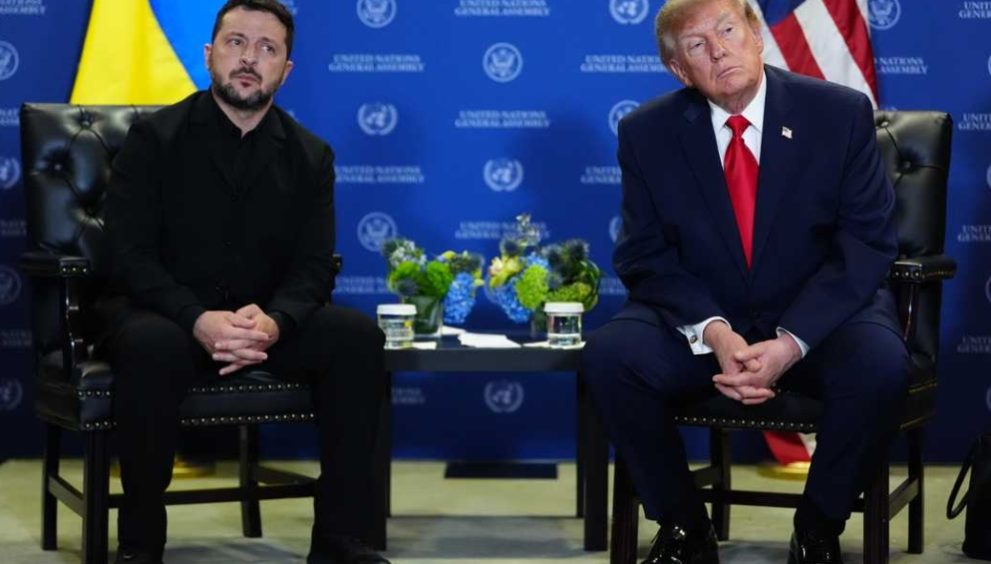
US President Donald Trump has called for Ukraine to elect a new president, arguing that President Volodymyr Zelenskyy has failed to reach an agreement to end Russia’s war against the country. The remarks have intensified tensions between Washington and Kyiv amid disagreements over Ukraine’s military strategy, Russian energy exports and ongoing diplomatic efforts to secure peace.
Trump made the comments on Saturday, October 10, accusing Zelenskyy of repeatedly missing opportunities to negotiate an end to the conflict, which began with Russia’s full-scale invasion of Ukraine in February 2022.
“I suggest they get a new leader who can make a deal because he could have made many deals and for some reason he never does,” Trump told reporters at the White House.
The US president also criticised Ukraine’s attacks on Russian oil refineries, arguing that the strikes were contributing to international diesel supply pressures and increasing costs for American farmers and ranchers.
Trump Links Ukraine’s Attacks to Rising Fuel Prices
Trump’s criticism followed an announcement that the United States had reached an arrangement with Russian President Vladimir Putin to facilitate Russian diesel supplies to international markets as fuel prices remain elevated.
The move is intended to ease pressure on energy costs in the United States ahead of the November midterm elections. However, the arrangement has drawn criticism from Ukrainian officials and European allies, who fear that easing restrictions on Russian energy exports could generate additional revenue for Moscow to sustain its military campaign.
Zelenskyy has condemned the deal, warning that reducing economic pressure on Russia could encourage further attacks against Ukrainian cities and infrastructure.
Trump, meanwhile, has urged Kyiv to stop targeting Russian energy facilities, arguing that such operations risk worsening fuel supply problems beyond the battlefield.
The disagreement highlights a growing divide over how to end the war, with Washington pressing for a negotiated settlement while Ukraine insists that any agreement must protect its sovereignty and provide credible security guarantees.
Zelenskyy Offers Conditional Halt to Energy Strikes
In response to the escalating dispute, Zelenskyy said on Sunday that Ukraine was prepared to stop attacking Russian oil refineries if Moscow halted its strikes against Ukrainian energy infrastructure.
The Ukrainian president maintained that any de-escalation must be reciprocal and supported by meaningful guarantees.
He argued that Russia remained responsible for the war and accused Moscow of interpreting reduced international pressure as an opportunity to intensify its military operations.
Zelenskyy’s position reflects Kyiv’s continued reliance on long-range drone attacks against Russian military and energy-related targets as part of its strategy to weaken Moscow’s capacity to finance and sustain the invasion.
The proposal for a mutual halt to attacks on energy infrastructure could offer a limited opening for de-escalation, although there is no confirmed agreement between the two sides to implement such a truce.
Peace Talks Face an Uncertain Path
The latest exchange comes as diplomatic efforts to develop a framework for ending the war continue. Ukrainian officials recently held discussions with US representatives in Miami, while reports have suggested that American envoys Steve Witkoff and Jared Kushner could travel to Moscow for further negotiations.
However, major obstacles remain, including disagreements over occupied Ukrainian territory, security guarantees, military operations and the conditions under which a ceasefire could be implemented.
Trump has repeatedly argued that the war could have been avoided or ended through negotiations, while Zelenskyy has insisted that peace cannot come at the expense of Ukraine’s independence or leave the country vulnerable to renewed Russian aggression.
The latest dispute over Russian diesel supplies and attacks on energy infrastructure threatens to complicate an already difficult diplomatic process.
As the war continues, the central challenge for international mediators remains finding an agreement that can halt the fighting while addressing the security concerns of Ukraine and the wider European region.
________________________________________________________________________________________________________________