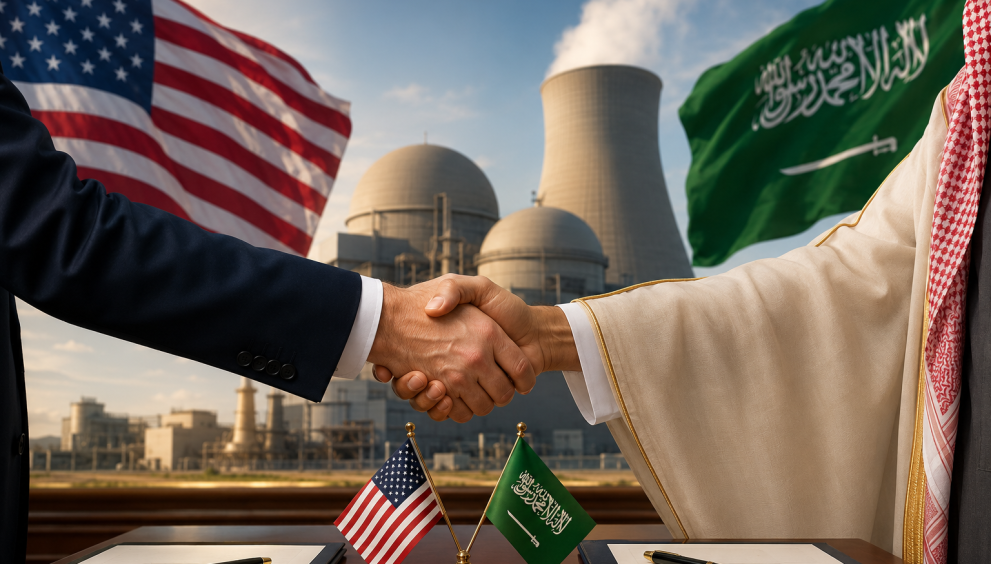
U.S. President Donald Trump has approved a landmark 30-year civilian nuclear cooperation agreement with Saudi Arabia, paving the way for one of the most significant energy and geopolitical partnerships between Washington and Riyadh in decades. The agreement, expected to be worth tens of billions of dollars, marks a major diplomatic victory for the Saudi kingdom while reigniting international debate over nuclear proliferation in the Middle East.
The proposed agreement, commonly known as a “123 Agreement” under the U.S. Atomic Energy Act, would allow American companies to participate in building Saudi Arabia’s civilian nuclear energy infrastructure, including nuclear reactors and related technology. Unlike previous U.S. nuclear agreements with other allies, however, this pact could permit Saudi Arabia to enrich uranium on its own soil under certain conditions.
A Major Step in U.S.-Saudi Relations
The deal represents another milestone in the strengthening relationship between President Trump and Saudi Crown Prince Mohammed bin Salman. Both governments have emphasized expanding cooperation across defense, energy, technology, and investment, and the nuclear agreement further cements Saudi Arabia as one of Washington’s most important strategic partners in the Middle East.
The Trump administration argues the agreement will:
- Expand U.S. influence over Saudi Arabia’s nuclear development.
- Create billions of dollars in opportunities for the American nuclear industry.
- Counter growing Chinese and Russian involvement in global nuclear infrastructure projects.
- Help Saudi Arabia diversify its economy beyond oil under its Vision 2030 modernization strategy. (
Saudi Arabia’s Nuclear Ambitions
Saudi Arabia has long sought to develop a civilian nuclear energy program as part of its broader strategy to reduce dependence on oil and meet rising domestic electricity demand.
Officials in Riyadh insist the program is intended solely for peaceful purposes, including electricity generation, desalination, and scientific research.
However, the possibility that Saudi Arabia could eventually enrich uranium domestically has drawn widespread international attention because uranium enrichment technology can be used both for civilian nuclear fuel and, if pursued beyond peaceful limits, for nuclear weapons production.
Controversy Over Missing Safeguards
Perhaps the most controversial aspect of the agreement is what it reportedly leaves out.
According to multiple reports, the proposed deal does not require Saudi Arabia to adopt two key non-proliferation measures that have been included in several previous U.S. nuclear agreements:
- The “Gold Standard”, under which countries agree not to enrich uranium or reprocess spent nuclear fuel.
- The IAEA Additional Protocol, which grants the International Atomic Energy Agency expanded authority to conduct inspections and verify peaceful nuclear activities.
Non-proliferation experts argue these safeguards are essential to reducing the risk that civilian nuclear technology could eventually be diverted toward military purposes.
Congress Set for Heated Debate
The agreement is expected to be formally submitted to the U.S. Congress, triggering a 90-day review period required under American law.
Although Congress has the authority to block the agreement, doing so would require enough support to overcome a potential presidential veto a high political threshold.
Several lawmakers from both parties have already expressed concern that the agreement could weaken long-standing U.S. nuclear non-proliferation standards, particularly given ongoing regional tensions with Iran.
Regional Security Implications
The announcement comes amid heightened tensions across the Middle East following recent conflicts involving Iran and ongoing concerns over Tehran’s nuclear activities.
Critics argue the agreement could encourage a regional nuclear competition if neighboring countries seek similar enrichment capabilities.
Saudi Crown Prince Mohammed bin Salman has previously stated that if Iran were ever to acquire a nuclear weapon, Saudi Arabia would likely pursue one as well a remark frequently cited by opponents of the agreement.
Supporters of the deal counter that maintaining U.S. involvement in Saudi Arabia’s nuclear development provides greater oversight than allowing Riyadh to turn to rival suppliers such as China or Russia.
Economic Benefits
Beyond its strategic implications, the agreement is expected to generate substantial economic opportunities for the United States.
American nuclear engineering firms, reactor manufacturers, construction companies, and technology suppliers could secure contracts worth tens of billions of dollars over the next three decades.
The deal is also expected to support thousands of high-skilled jobs in the U.S. energy sector while reinforcing America’s role as a leading exporter of civilian nuclear technology.
Looking Ahead
The proposed agreement is likely to remain one of the most closely watched foreign policy initiatives of President Trump’s second term. Supporters view it as a strategic investment that strengthens ties with a key regional ally and expands U.S. economic influence, while critics warn it could reshape global nuclear non-proliferation norms and increase security risks in an already volatile region.
As Congress prepares to examine the agreement, lawmakers, international watchdogs, and Middle Eastern governments will be watching closely to determine whether the deal proceeds in its current form or is modified to include stronger safeguards against nuclear proliferation.
________________________________________________________________________________________________________________