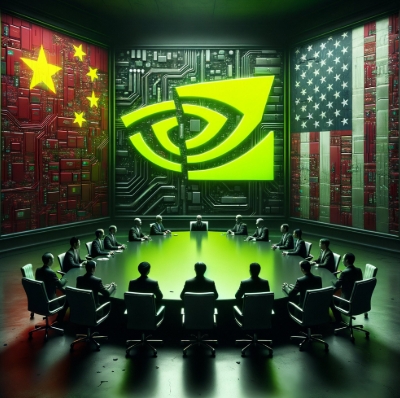
The United States has approved limited exports of Nvidia’s high-performance H200 artificial intelligence chips to around 10 Chinese companies, marking a significant but highly constrained step in easing tensions over advanced semiconductor trade between Washington and Beijing.
However, despite the clearance, no shipments have yet taken place, leaving the deal in limbo as regulatory conditions, geopolitical concerns and Chinese hesitancy continue to delay implementation.
The development comes as Nvidia CEO Jensen Huang accompanies U.S. President Donald Trump on a high-level visit to Beijing, where technology and trade have emerged as central topics in discussions with Chinese President Xi Jinping.
Limited Approval for Select Chinese Tech Giants
According to officials and industry sources, the U.S. Commerce Department has authorized exports of the H200 chip to approximately 10 Chinese firms, including major technology players such as Alibaba, Tencent, ByteDance, JD.com, Lenovo and Foxconn-linked distributors.
Each approved company is reportedly subject to strict licensing conditions, including purchase caps and security requirements designed to ensure the chips are not used for military applications.
The H200, one of Nvidia’s most advanced AI chips, is considered critical for training large-scale artificial intelligence models and powering data-heavy computing systems.
No Shipments Yet Amid Regulatory Gridlock
Despite formal approval, the export process remains stalled.
Chinese authorities have reportedly advised domestic firms to delay or avoid purchases, citing concerns over dependency on U.S. technology and broader national security considerations.
At the same time, U.S. regulations require additional compliance steps, including third-party verification and restrictions on chip usage, further slowing potential deliveries.
Industry sources say the combination of regulatory scrutiny on both sides has created a “limbo situation,” where licenses exist but commercial transactions have not yet materialized.
Nvidia Pushes for Breakthrough in China
Nvidia CEO Jensen Huang’s presence in Beijing is seen as part of a broader effort to unlock the stalled deal and restore the company’s access to one of its most important markets.
China remains a crucial region for Nvidia’s long-term growth, particularly as demand for AI infrastructure continues to expand rapidly. However, U.S. export controls on advanced semiconductors have significantly reduced Nvidia’s market share in China in recent years.
Analysts say Huang is attempting to balance Washington’s national security concerns with Beijing’s push for technological self-sufficiency, in what has become one of the most sensitive commercial issues in global tech.
Strategic AI and Geopolitical Stakes
The H200 chip approval reflects a carefully managed compromise in the broader U.S.-China technology rivalry.
Washington has sought to limit China’s access to cutting-edge AI hardware due to concerns over potential military applications, while still allowing restricted commercial sales under strict oversight frameworks.
Beijing, meanwhile, has accelerated efforts to develop domestic alternatives, including state-backed semiconductor initiatives aimed at reducing reliance on U.S. technology.
Market Impact and Industry Response
The announcement has already influenced financial markets, with Nvidia’s stock rising on expectations that even limited Chinese sales could generate significant revenue opportunities.
Analysts estimate that if fully implemented, the approved licenses could represent billions of dollars in potential sales, though actual figures depend on shipment approvals and compliance outcomes.
However, uncertainty remains high, with investors closely watching whether the geopolitical environment will allow the deal to move forward or remain stalled indefinitely.
Outlook
While the U.S. approval signals cautious progress in easing export restrictions, the lack of actual shipments underscores the continuing fragility of U.S.-China tech relations.
For Nvidia, the coming weeks are critical as diplomatic negotiations in Beijing may determine whether the H200 deal becomes a breakthrough moment or another stalled chapter in the escalating global AI chip rivalry.
what are the chips used for
The Nvidia H200 chips are high-end AI computing processors used mainly for very heavy data and artificial intelligence workloads.
Here’s what they are used for in simple terms:
1. Training AI models
They are used to train large AI systems like:
- Chatbots (similar to ChatGPT-type systems)
- Image generators (AI that creates pictures or video)
- Voice assistants
- Translation systems
Training means feeding huge amounts of data so the AI “learns” patterns.
2. Running AI services (inference)
After AI is trained, H200 chips are used to run the AI in real time, such as:
- Answering user questions instantly
- Generating images or text
- Powering search engines with AI features
- Supporting smart apps and cloud services
3. Data centers and cloud computing
These chips are mostly installed in large data centers, not personal computers. They power:
- Cloud platforms (like AWS, Azure, Google Cloud)
- Corporate AI systems
- Research supercomputers
4. Scientific and industrial research
They are also used in:
- Drug discovery and medical research
- Climate modeling
- Financial forecasting
- Engineering simulations (cars, planes, etc.)
Why they matter so much
The H200 is part of a class of chips called AI accelerators, designed to do massive math calculations extremely fast. AI models today are so large that normal computer chips cannot handle them efficiently.
That’s why countries like the U.S. and China treat them as strategic technology, not just ordinary electronics.
If you want, I can also explain the difference between H100 vs H200 vs China’s own AI chips.
________________________________________________________________________________________________________________