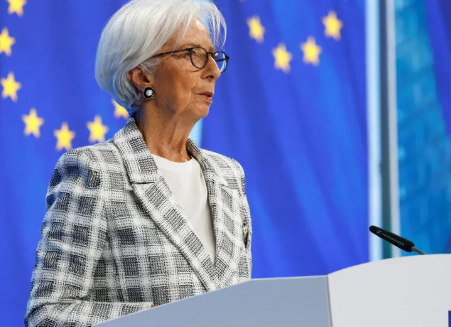
European Central Bank (ECB) President Christine Lagarde has announced that she will step down early from her position, saying she wants greater freedom to speak publicly about issues beyond monetary policy.
Lagarde made the announcement on Thursday, October 29, confirming that she will leave the central bank on February 7, 2027, rather than completing her term, which was due to end in October 2027. She has led the ECB since November 2019, following her tenure as managing director of the International Monetary Fund (IMF).
Explaining her decision, Lagarde said the neutrality required of ECB officials limits their ability to comment on matters outside the institution’s mandate. She said she wanted the freedom to express her views and participate in discussions on broader global issues.
Lagarde also spoke about concerns over the misrepresentation of facts in public debate, saying she believed her experience in international economic and financial institutions could contribute to discussions beyond central banking. However, she did not specify which issues she intends to address after leaving office.
Her departure comes at a significant time for the eurozone economy. The ECB continues to face challenges linked to inflation, energy prices and uncertainty in financial markets. The central bank’s decisions on interest rates affect borrowing costs for households and businesses, as well as economic activity across the eurozone.
Lagarde’s announcement also sets in motion the process of selecting her successor. European Council President António Costa said the appointment process would begin immediately. The timing has attracted attention because it allows European Union leaders to choose a new ECB president before France’s 2027 presidential election.
Among the names being discussed as potential successors are former Dutch central bank governor Klaas Knot and Pablo Hernández de Cos, the former governor of Spain’s central bank and current head of the Bank for International Settlements. The final appointment will depend on negotiations among European leaders.
Lagarde has sought to reassure markets and ECB staff that her early departure will not disrupt the institution’s operations. She described the ECB as strong and stable, expressing confidence that it would continue to carry out its responsibilities throughout the transition.
Her departure will bring an early close to a presidency that has spanned the COVID-19 pandemic, Russia’s invasion of Ukraine and renewed inflationary pressures. As preparations for a leadership change begin, attention will turn to the selection of her successor and the future direction of monetary policy in the eurozone.