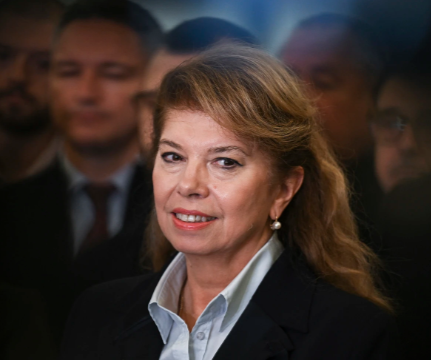
Bulgaria’s incumbent President Iliana Iotova has won the presidential runoff with 57.58% of the vote, according to near-final election results, becoming the country’s first directly elected female head of state.
Iliana Iotova has secured victory in Bulgaria’s presidential runoff, defeating her pro-Western challenger, former caretaker Prime Minister Andrey Gyurov, in an election shaped by divisions over the country’s relationship with Russia and its position on the war in Ukraine.
With 99.95% of polling station protocols processed, figures from Bulgaria’s Central Election Commission showed that Iotova and her running mate, Kiril Valchev, received 57.58% of the vote. Gyurov and his running mate, Georgi Kandev, secured 39.47%, while approximately 2.95% of voters selected the option indicating that they did not support any candidate.
The victory makes Iotova the first woman to be directly elected president of Bulgaria. She assumed the presidency on an acting basis in January 2026 after Rumen Radev stepped down to enter parliamentary politics.
Her campaign was closely associated with Radev’s political camp, which advocates dialogue with Moscow and a diplomatic solution to the war in Ukraine. Iotova has supported Bulgaria’s continued membership of the European Union and NATO while calling for improved relations with Russia and opposing additional military assistance to Ukraine.
Gyurov, who was backed by pro-Western opposition parties, had campaigned for closer cooperation with Western allies and stronger support for Kyiv. Following the results, he acknowledged the outcome and said the vote of Bulgarian citizens had to be accepted.
Turnout remained low, with projections placing participation at approximately 27%, reflecting continuing public disengagement with politics in the country.
The election took place amid heightened security concerns over drone attacks on commercial vessels in the Black Sea and the wider implications of Russia’s war against Ukraine. Bulgaria’s position within the EU and NATO, alongside its historically close ties with Russia, made the presidential contest significant for the country’s foreign policy direction.
Although Bulgaria’s presidency is largely ceremonial, the office carries important responsibilities, including serving as commander-in-chief of the armed forces, signing international treaties and exercising veto powers over legislation.
Iotova’s victory is expected to maintain continuity with Radev’s political direction, while placing renewed attention on how Bulgaria balances its European commitments with calls for dialogue with Moscow.