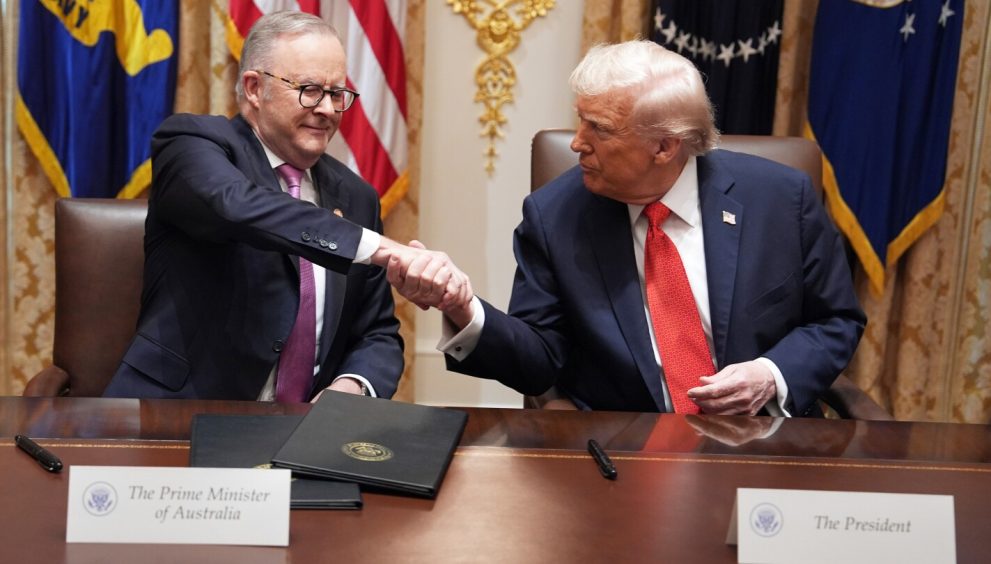
U.S. President Donald Trump and Australian Prime Minister Anthony Albanese signed a new agreement on Monday to secure supplies of rare earths and critical minerals, aiming to stabilise access to these strategic resources amid efforts by China to strengthen its control over the global supply chain.
China was a central topic during the leaders’ first official summit at the White House, where Trump also voiced support for a key defence initiative involving nuclear-powered submarines — a move intended to counter China’s expanding influence in the Indo-Pacific.
The meeting opened with the announcement of the minerals agreement, which Trump described as the result of recent negotiations. Albanese called it an “$8.5 billion pipeline ‘that we have ready to go.”
According to information from the Australian prime minister’s office, both countries will contribute $1 billion over the next six months to fund mining and processing initiatives. The deal also introduces a price floor for critical minerals — a provision long advocated by Western mining companies.
“In about a year from now, we’ll have so much critical mineral and rare earths that you won’t know what to do with them,” Trump told reporters.
The U.S. has been actively seeking diversified sources of rare earths and related materials, which are vital for electric vehicles, defence systems, and aerospace technology. These efforts have intensified as China tightens export controls and trade tensions rise in advance of Trump’s upcoming meeting with Chinese President Xi Jinping in South Korea.
While China currently holds the world’s largest rare earth reserves, Australia is also a major producer, making the partnership strategically important.
Despite a largely cordial meeting, there was a brief uncomfortable moment when Trump was asked about past critical remarks made by Australia’s ambassador to the U.S., Kevin Rudd — comments that have since been deleted. Upon spotting Rudd at the meeting,
Trump said: “I don’t like you either – and I probably never will.”
Trump also voiced strong support for the AUKUS defence pact, a $368 billion arrangement reached in 2023 under President Joe Biden. The agreement outlines Australia’s plan to purchase U.S. nuclear-powered submarines beginning in 2032, followed by a joint effort with the U.K. to develop a new submarine class.
Although Trump’s administration launched a review of the deal over concerns about U.S. production capacity, he now appears committed to its continuation.
Navy Secretary John Phelan told the meeting that the U.S. and Australia are working closely to strengthen the original AUKUS framework and “clarify some of the ambiguity that was in the prior agreement.”
Trump dismissed lingering concerns: “There shouldn’t be any more clarifications, because we’re just, we’re just going now full steam ahead, building.”
Ahead of the meeting, Australian officials emphasised their financial commitment to the partnership, noting that Australia is contributing $2 billion this year to boost U.S. submarine manufacturing and preparing to host Virginia-class submarines at its Indian Ocean base from 2027.
The ten-month delay in organising an official bilateral meeting had caused some concern in Canberra, particularly as Washington pressed for increased Australian defence spending. Trump and Albanese had previously met briefly on the sidelines of the UN General Assembly in New York last month.
The minerals agreement comes shortly after U.S. officials condemned China’s expanded export restrictions on rare earths, which were seen as a risk to global supply chains.
In earlier trade discussions, Australia offered the U.S. preferential access to its strategic reserves. As part of the new deal, both leaders agreed to speed up permitting for new mining and processing projects, enhance collaboration on geological surveys, promote recycling of minerals, and restrict the sale of critical resource assets on national security grounds.
That last measure is seen as a veiled reference to China, which has spent the past decade acquiring key mining operations worldwide — including the world’s largest cobalt mine in the Democratic Republic of Congo, previously owned by a U.S. company.