Abu Dhabi Accuses Iraqi-Based Groups After Strike Near Barakah Facility
The United Arab Emirates has announced that drones involved in an attack near the country’s Barakah Nuclear Power Plant were launched from Iraqi territory, escalating regional tensions as the conflict involving Iran, the United States, and Israel continues to spread across the Middle East.
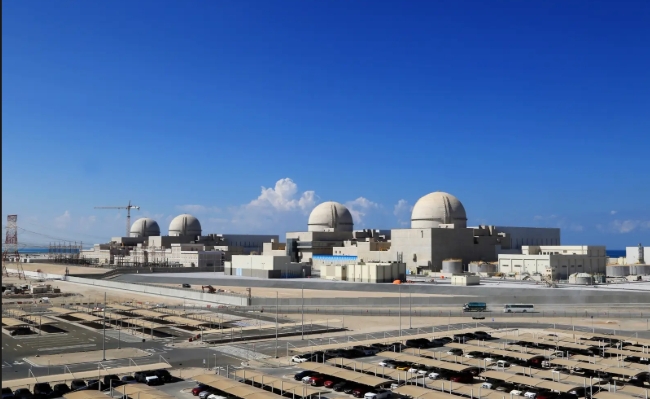
The UAE Ministry of Defence said multiple drones entered Emirati airspace over the past 48 hours, including one that struck near the Barakah nuclear facility in Abu Dhabi’s Al Dhafra region. Officials said the incident caused a fire involving an electrical generator near the plant’s perimeter but did not damage the nuclear reactors themselves.
Authorities confirmed there were no casualties and no radioactive leaks following the incident. Emergency teams quickly contained the fire while safety systems at the plant continued operating normally.
Barakah Plant at Center of Global Concern
The Barakah Nuclear Energy Plant is the Arab world’s first operational nuclear power facility and supplies roughly one-quarter of the UAE’s electricity needs. The plant has become increasingly important to the UAE’s long-term energy strategy as the country seeks to diversify beyond oil and gas dependence.
The attack has raised alarm internationally because military action involving nuclear facilities carries the risk of catastrophic environmental and humanitarian consequences.
At an emergency United Nations Security Council session, International Atomic Energy Agency (IAEA) Director General Rafael Grossi warned that a direct strike on an operational nuclear facility could lead to severe radioactive contamination.
According to reports, the drone strike temporarily disrupted external power systems connected to one of the reactors, forcing backup diesel generators to activate for a limited period before systems were restored.
UAE Points to Iraqi Territory
Emirati officials said investigations determined that the drones originated from Iraq, strongly suggesting the involvement of Iranian-backed militias operating in the country. No group has formally claimed responsibility for the attack so far.
Iran-backed armed factions in Iraq have previously launched drone and missile attacks targeting Gulf states and U.S. military installations in the region. Analysts say such groups often provide Tehran with plausible deniability while expanding pressure on regional rivals.
The Iraqi government condemned the attack but did not directly address the UAE’s accusations regarding the launch location. Baghdad instead called for regional cooperation to prevent further escalation and instability.
Regional Tensions Continue to Escalate
The incident comes amid growing instability across the Gulf region following months of military confrontation involving Iran and its regional allies.
Saudi Arabia recently reported intercepting drones approaching from Iraqi airspace, while Jordan said its air defenses shot down an unidentified drone this week.
The UAE has increasingly strengthened security around critical infrastructure, particularly energy and maritime assets, as concerns rise over additional attacks on oil facilities, desalination plants and transport networks.
The country is also accelerating efforts to expand oil export routes that bypass the Strait of Hormuz, one of the world’s most strategically important shipping lanes.
International Community Calls for Restraint
The drone strike has renewed international concern over the militarization of civilian infrastructure in the Middle East conflict.
Global nuclear safety experts warn that attacks near nuclear plants could trigger a broader international crisis if containment systems or reactor operations are compromised.
The United States and several Gulf allies have condemned attacks on civilian and energy infrastructure while urging renewed diplomatic negotiations with Tehran to prevent further escalation.
U.S. President Donald Trump recently warned that time for diplomacy with Iran was “running out” even as discussions over a possible ceasefire and broader regional settlement continue behind closed doors.
Energy Markets and Security in Focus
The strike has intensified fears about the security of Gulf energy infrastructure at a time when global oil markets are already facing volatility linked to disruptions in the Strait of Hormuz.
Energy analysts say any sustained attacks on major facilities in the UAE or neighboring Gulf states could significantly affect global fuel supplies and international shipping routes.
Despite the incident, UAE authorities emphasized that the Barakah plant remains fully operational and safe, while investigations into the drone launches continue.
________________________________________________________________________________________________________________