

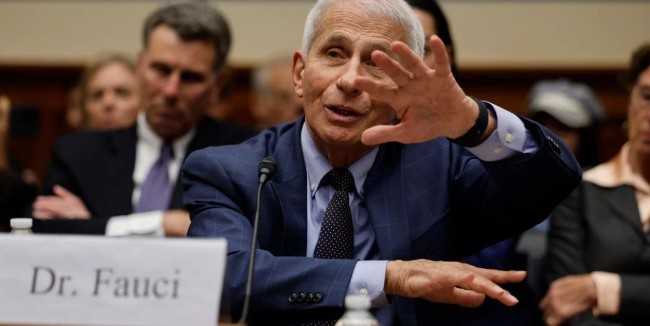
Newly released text messages are drawing renewed scrutiny over former U.S. health official Dr. Anthony Fauci’s discussions about COVID-19 vaccines and pregnancy.
On Monday, Republican Senators Ron Johnson and Rand Paul published extracts from messages sent from Fauci’s government mobile phone. According to the lawmakers, a January 2021 exchange involving Fauci, then CDC Director Rochelle Walensky, and Surgeon General Vivek Murthy included a discussion about whether the second dose of a COVID-19 vaccine could theoretically be associated with miscarriage during the first trimester.
Fauci reportedly raised the possibility because of the strong immune response and fever that some people experienced following the second dose.
The messages have prompted criticism because Fauci’s private discussion appeared more cautious than his public reassurances at the time.
In public appearances during the same period and afterward, Fauci said there was no indication of an increase in adverse pregnancy outcomes among vaccinated women and specifically stated that there was no elevated miscarriage risk compared with women who had not received a COVID-19 vaccine.
What makes the disclosure particularly controversial is the contrast between that private discussion and the reassuring language Fauci used publicly around the same period.
The world deserved to hear clearly about uncertainty and potential concerns being considered by the very officials responsible for shaping national health policy. Instead, public messaging often projected a much greater level of certainty, raising questions about whether the public received the full picture.
The revelations are likely to intensify criticism of Fauci’s leadership during the pandemic and fuel broader questions about transparency, informed consent and accountability within federal health agencies.
The controversy is not simply about whether a theoretical concern ultimately proved correct. It is also about how government health officials communicated uncertainty while making recommendations that affected millions of people.
The newly released messages are therefore adding another chapter to the continuing debate over Fauci’s handling of COVID-19, with lawmakers now examining whether the public was given complete and sufficiently transparent information as vaccination policies were being developed.
The newly released correspondence is therefore being presented as evidence of a gap between what was being discussed privately and what was communicated publicly.
However, raising a theoretical safety concern in a private scientific discussion does not by itself establish that vaccination caused miscarriages. The significance of the messages depends on the broader scientific evidence available at the time and subsequent research.
The revelations are nevertheless likely to intensify debate over transparency, informed consent, and how health officials communicated uncertainty during the COVID-19 pandemic.

