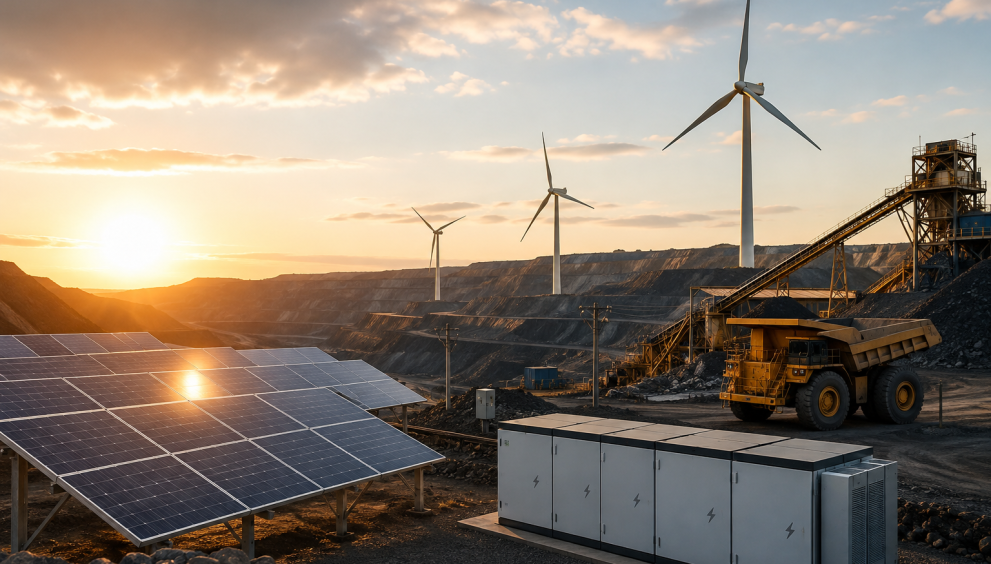
South Africa’s mining companies are accelerating investments in renewable energy as they seek to reduce dependence on Eskom, lower electricity costs and strengthen their operations against power-supply and grid constraints.
The shift marks a significant change for an industry that has historically relied heavily on Eskom’s coal-dominated electricity system. Mining companies are increasingly turning to solar, wind, battery storage, independent power producers and electricity-wheeling arrangements to diversify their energy supplies.
South Africa still generates more than 80% of its electricity from coal, while renewable sources account for roughly 10%. Although Eskom’s power reliability has improved from the worst periods of load shedding, mining executives say the national utility is likely to remain an important source of baseload electricity for years to come.
Mining Companies Invest in Their Own Power
Anglo American is among the companies pursuing renewable-energy partnerships. In 2022, the mining group established a 50-50 joint venture with EDF power solutions to develop renewable electricity for businesses including Kumba Iron Ore and De Beers. The strategy is designed to provide more predictable energy supplies while supporting emissions-reduction targets.
Sibanye-Stillwater has adopted a different approach, favouring power-purchase and offtake agreements rather than owning all of its renewable-generation assets. Such arrangements allow mining companies to secure renewable electricity without necessarily carrying the full cost and operational responsibility of developing power plants themselves.
The trend is also visible among coal producers. Exxaro commissioned its Lephalale Solar Project in July, describing it as the first utility-scale renewable-energy asset developed for its own operations. The company has said it aims to power all of its coal-mining operations with renewable energy by 2030.
Wind and Solar Projects Expand
Seriti Resources has also emerged as a major example of mining companies using renewable power directly. The first phase of its Ummbila Emoyeni wind project entered commercial operation in July, generating 155 megawatts from 25 turbines. The electricity is being wheeled through Eskom’s transmission network to supply Seriti’s coal-mining operations.
The broader project is expected to develop into a 900MW hybrid renewable-energy cluster combining wind, solar and battery storage.
Meanwhile, platinum-group metals producer Tharisa is expanding renewable-energy use at its South African operations. Its existing 40MW solar photovoltaic plant can provide up to 30% of the electricity required by its operations, supporting the company’s objective of reducing its carbon footprint while improving energy resilience.
Eskom Also Seeks Role in the Transition
The move away from traditional Eskom dependence does not necessarily mean mining companies are abandoning the national grid. Instead, many are seeking a more diversified electricity model in which Eskom transmission infrastructure, renewable generators and private power producers operate together.
Eskom launched Eskom Green in June as a dedicated renewable-energy business aimed partly at large industrial customers, including mining and manufacturing companies. The utility has identified projects that could provide approximately 6GW of additional capacity by 2030 and about 32GW by 2040, combining renewable generation with existing infrastructure and storage.
This could allow Eskom to remain a key part of the mining industry’s electricity system while gradually reducing the sector’s exposure to coal-based generation and conventional grid supply.
Cost and Decarbonisation Drive the Shift
For mining companies, the renewable-energy transition is being driven by more than environmental commitments. Electricity is one of the largest operating costs for energy-intensive mines, smelters and processing facilities. Companies are therefore seeking long-term power contracts that can provide greater price certainty.
Renewable electricity is also becoming increasingly important for mining companies that export commodities to international markets. Global customers and investors are placing greater emphasis on the carbon intensity of minerals, creating pressure on producers to reduce emissions throughout their operations.
At the same time, private generation can provide a degree of protection against disruptions and grid constraints, helping mines maintain production when electricity supply becomes unstable.
Eskom Still Expected to Play a Major Role
Despite the rapid expansion of renewable projects, industry executives do not expect Eskom to disappear from the mining sector’s energy mix.
Renewable sources such as wind and solar are intermittent, meaning mines still require reliable electricity when renewable generation is unavailable. Grid power, battery storage and other forms of firming capacity therefore remain important to maintaining continuous mining operations.
South Africa’s energy transition is consequently developing as a hybrid model rather than an immediate replacement of coal and Eskom with renewables.
The mining industry’s growing investment in wind, solar and storage nevertheless represents a structural shift in how South Africa’s largest electricity users approach energy security. As private renewable generation expands, mining companies could become increasingly independent from Eskom while simultaneously contributing to the country’s broader decarbonisation and energy-transition goals.