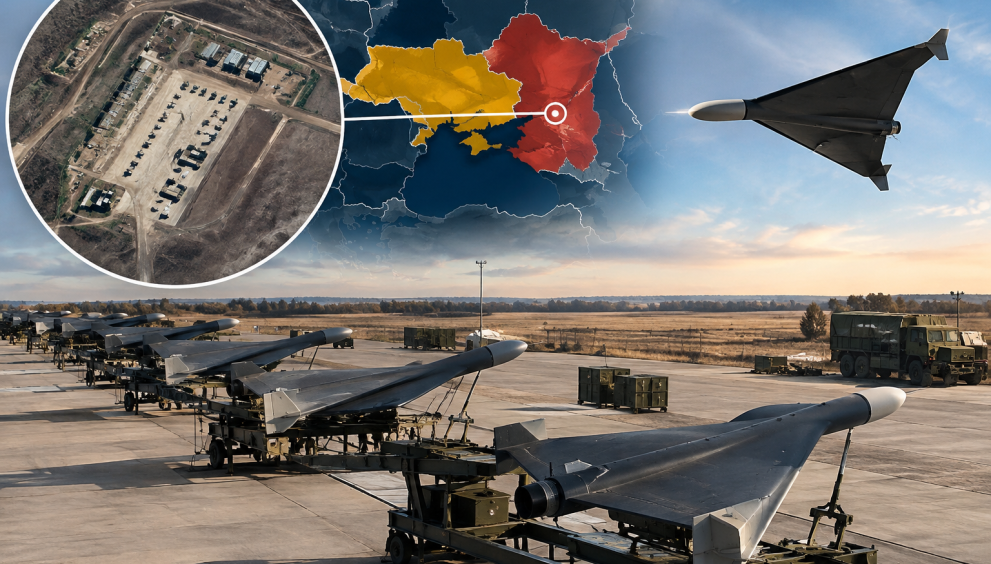
Russia has constructed a major new drone launch facility near Ukraine in approximately six weeks, according to satellite imagery and defence analysts. The rapid development highlights Moscow’s growing reliance on unmanned aerial weapons in its ongoing war against Kyiv.
The facility, located in Russia’s Rostov region near the Millerovo air base, is designed to support the launch of advanced jet-powered attack drones, including the Geran-4 and Geran-5 models. Its construction reflects Russia’s efforts to expand its capacity to conduct sustained aerial attacks against Ukrainian targets.
The new site reportedly covers approximately 0.9 square kilometres, making it a substantial addition to Russia’s expanding network of drone launch installations. Satellite imagery indicates that construction progressed rapidly between early September and mid-October.
New Base Designed to Support Advanced Attack Drones
The installation reportedly features eight launch platforms, some already equipped with launch rails. The infrastructure is intended to support jet-powered drones capable of travelling faster than conventional propeller-driven models.
The Geran series forms part of Russia’s long-range strike capability and has been used in attacks against Ukrainian military positions, infrastructure and urban areas. The development of faster variants presents additional challenges for Ukrainian air defences, which must identify, track and intercept incoming aerial threats.
The expansion of dedicated launch infrastructure could allow Russia to organise drone operations on a greater scale, potentially enabling more frequent attacks and placing additional pressure on Ukraine’s defensive resources.
Satellite Images Reveal Rapid Construction
Satellite imagery has provided evidence of the speed at which the facility was developed. Its location near Millerovo places it within an established Russian military aviation area in the Rostov region.
The construction comes as Russia continues to expand its use of drones alongside missile strikes in the war against Ukraine. The growing role of unmanned systems has made drone production, storage, launch infrastructure and interception capabilities increasingly important components of the conflict.
The new base’s proximity to existing military facilities could support the coordination of drone operations. However, its full operational status and the scale of its current deployment remain subject to further assessment.
Potential to Launch More Than 100 Drones in 24 Hours
Defence experts reportedly assess that the facility could potentially support the launch of more than 100 drones within a 24-hour period. If fully utilised, this capacity could significantly increase the volume of aerial threats Ukraine would need to counter.
Large-scale drone attacks can stretch air-defence systems by forcing defenders to track and engage numerous targets simultaneously. They can also require Ukraine to expend interceptors and other defensive resources that may be needed to protect critical infrastructure and population centres.
The faster flight speeds of jet-powered drones could further complicate interception. However, their effectiveness depends on several factors, including detection capabilities, flight paths, electronic warfare and the defensive systems deployed against them.
Ukraine Faces an Intensifying Drone Threat
Russia’s new installation comes as the country continues its extensive drone campaign against Ukraine. On October 15, Ukrainian authorities reported a major overnight drone assault, with the Ukrainian Air Force saying Russia had launched 580 drones nationwide.
Three people were reported killed in the central Kirovohrad region, according to regional officials.
The scale of the attacks highlights the continuing challenge facing Ukraine as it seeks to protect civilians, energy infrastructure, transport networks and military facilities from repeated aerial bombardment.
Ukraine has also pursued long-range strikes against Russian military and strategic infrastructure, making drone launch sites and related facilities important targets in the wider conflict.
Broader Security Implications
Russia’s rapid construction of the facility illustrates how quickly military infrastructure can be expanded to meet the demands of modern warfare. It also raises wider security concerns for European countries, particularly if improvements in drone speed, range and launch capacity increase pressure on regional air-defence networks.
For Ukraine, the immediate challenge will be adapting its defences to evolving Russian drone technology while maintaining protection against missiles and other aerial threats.
The full operational capacity of the new base, the number of drones currently stationed there and its eventual contribution to Russian attacks remain matters for further assessment.
As the war continues, the expansion of drone infrastructure is likely to remain a significant factor in the conflict, influencing military planning, air-defence requirements and security calculations across Europe.