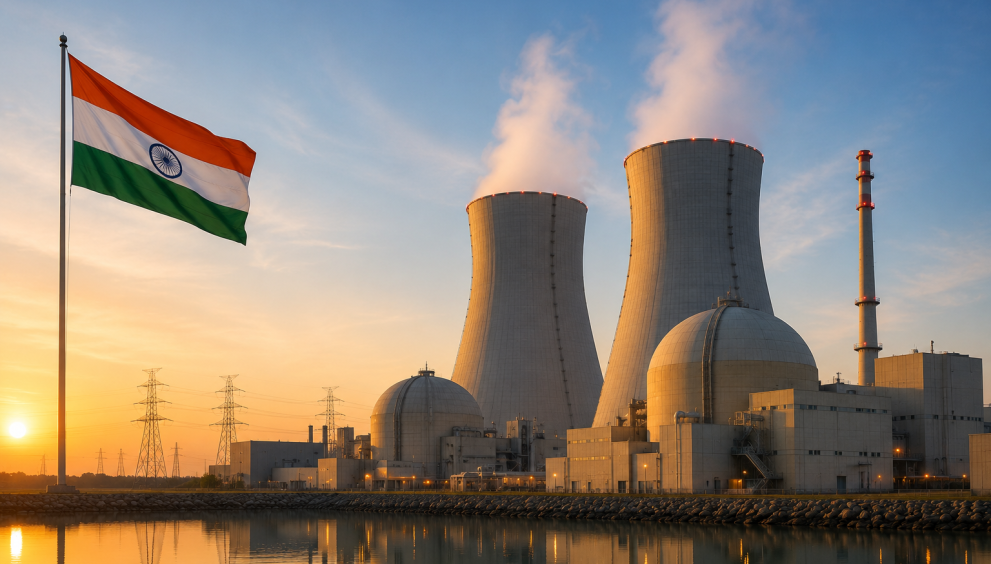
India’s ambitious plan to dramatically expand nuclear power generation could face delays and reduced foreign investment under proposed regulations that impose additional approval requirements on imported reactor technologies.
A draft regulatory framework released for public consultation could make it more difficult for foreign reactor manufacturers to participate in India’s nuclear expansion, despite a major reform last year that opened the previously tightly controlled sector to private companies and international technology providers.
India Targets 100 GW of Nuclear Capacity
New Delhi aims to increase nuclear power capacity from about 8.8 gigawatts today to 100 GW by 2047, requiring an estimated $210 billion in investment. The expansion is intended to provide reliable, low-carbon electricity while reducing the country’s heavy dependence on coal.
India’s Nuclear Energy Mission combines domestically developed reactors with large imported advanced reactors and small modular reactors (SMRs). The government expects existing projects to raise capacity to around 22 GW by 2031-32.
Tougher Rules for Imported Reactors
Under the proposed framework, companies seeking to build imported reactors would need operational and licensing certification from the reactor’s country of origin, as well as separate design approval from India’s atomic energy regulator before construction could begin.
Industry experts warn that these requirements could discourage foreign companies, particularly those developing newer reactor designs that have not yet achieved commercial operation elsewhere. The concern is particularly significant for SMRs, many of which are still at early stages of commercial deployment.
The draft also creates uncertainty over how long regulatory approvals could take because it does not establish binding deadlines for design approvals. Industry representatives say lengthy approval processes could make major projects harder to finance and slow construction.
Foreign Companies Are Watching Closely
Several major Indian and international companies have shown interest in the emerging market, including Tata Power, Adani Power and Reliance Industries, as well as Russia’s Rosatom, France’s EDF and U.S.-based GE Hitachi.
However, companies are reportedly waiting for greater clarity on the final regulations before committing major investments. Businesses have until September 4 to submit feedback on the proposed rules.
The draft also leaves important commercial questions unresolved, including electricity tariffs, investor returns, operator qualifications, fuel arrangements and other conditions that could determine whether nuclear projects are financially viable.
Safety Versus Speed
Indian officials have defended the framework as necessary to maintain strict safety standards and said it is aligned with international nuclear regulatory practices.
The government is simultaneously pursuing greater nuclear self-reliance. India is developing indigenous SMRs, including the 220-MW Bharat Small Modular Reactor and a 55-MW design, while targeting at least five indigenous SMRs by 2033.
The challenge for New Delhi will be balancing that domestic technology strategy with the need for foreign expertise, capital and proven reactor designs.
What It Means for India’s Nuclear Ambitions
India’s nuclear expansion is central to its long-term energy strategy and climate goals. However, experts warn that regulations perceived as favouring domestic technology could limit access to advanced foreign reactors and slow the flow of investment.
The rules are expected to be finalised about three months after the public consultation process. The final framework will determine whether India can attract the international technology and capital needed to accelerate its nuclear build-out while maintaining the strict safety oversight expected of a rapidly expanding nuclear sector.
________________________________________________________________________________________________________________