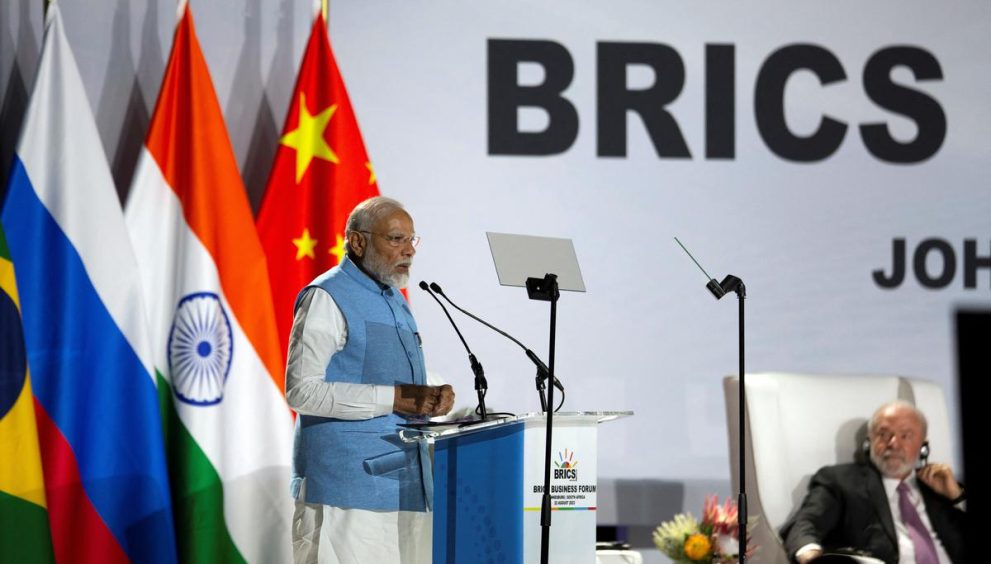
India is seeking to steer BRICS toward a more pragmatic and economically focused agenda as it prepares to host the group’s 18th leaders’ summit in New Delhi on September 12–13, 2026. The approach reflects New Delhi’s effort to strengthen the Global South while avoiding turning the expanded bloc into an explicitly anti-Western alliance.
India Pushes Pragmatic Cooperation
Under its 2026 BRICS chairship, India has adopted the theme “Building for Resilience, Innovation, Cooperation and Sustainability.” The priorities include trade, digital cooperation, technology, resilient supply chains, sustainable development, infrastructure and financial cooperation.
Rather than concentrating solely on geopolitical confrontation with Western powers, India is expected to promote BRICS as a platform through which emerging economies can secure greater influence in global economic governance and international institutions.
Balancing Relations With the West
India’s position reflects its broader strategy of maintaining strategic autonomy. New Delhi has deepened cooperation with BRICS members such as Russia and China while simultaneously maintaining important economic, defence and technological relationships with the United States and other Western countries.
The summit therefore presents India with a delicate diplomatic balancing act: strengthening cooperation among emerging economies without allowing BRICS to become defined primarily by opposition to Washington and the G7.
China, Russia and the Expanded BRICS
The summit comes as India and China have taken steps to stabilize relations following years of tensions linked to their disputed Himalayan border. Chinese President Xi Jinping is expected to attend the New Delhi gathering, making the summit an important opportunity for further diplomatic engagement between the two Asian powers.
Russia is also expected to remain a major voice within the bloc. Ahead of the summit, Kremlin spokesperson Dmitry Peskov said Moscow was not seeking outright “de-dollarisation” and remained open to different international payment methods, suggesting that financial cooperation within BRICS may focus more on flexibility than on an immediate attempt to displace the U.S. dollar.
A More Inclusive Global South Platform
BRICS has expanded significantly beyond its original membership, bringing in countries including Egypt, Ethiopia, Iran, Indonesia, Saudi Arabia and the United Arab Emirates alongside Brazil, Russia, India, China and South Africa.
The expansion has increased the bloc’s economic and diplomatic weight, but it has also introduced a wider range of national interests. India’s challenge in New Delhi will be to find common ground among members while presenting BRICS as a constructive voice for developing and emerging economies.
The September summit is consequently expected to test whether BRICS can evolve from a loosely aligned political grouping into a more practical platform for economic cooperation, institutional reform and Global South representation without becoming a formal counterweight to the West.
________________________________________________________________________________________________________________