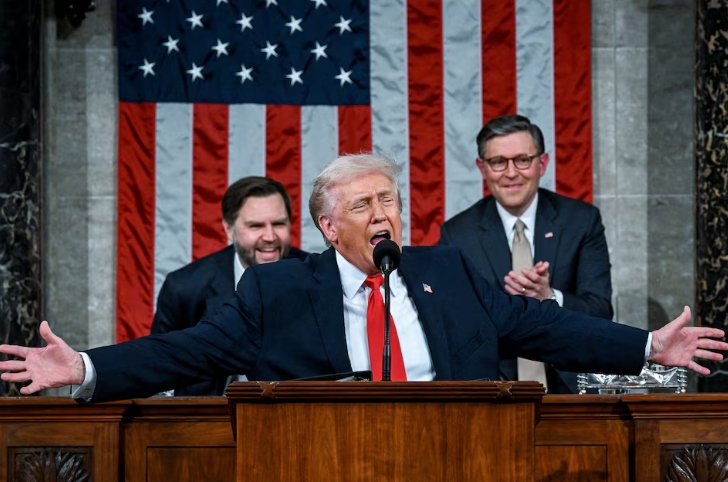
In a high stakes address to a joint session of Congress, President Donald Trump delivered a forceful and wide-ranging speech that underscored his administration’s policy priorities, sharpened partisan contrasts and laid out an ambitious vision for the year ahead. Speaking from the chamber floor before lawmakers, Cabinet officials and invited guests, Trump framed his agenda as a continuation of his “America First” platform, while challenging political opponents at home and rivals abroad.
Here are the key takeaways from the address:
________________________________________________________________________________________________________________
1. A Renewed Focus on Border Security and Immigration
Immigration once again took center stage. Trump called for stricter border enforcement, expanded physical barriers along the southern border, and reforms to the asylum system. He argued that enhanced border controls are essential to national security and economic stability.
The president also pressed Congress to pass legislation increasing funding for immigration enforcement agencies, portraying the issue as a defining test of Washington’s resolve. The proposal drew visible support from members of the Republican Party, while Democrats signaled continued resistance to measures they view as overly punitive.
2. Economic Optimism Coupled with Policy Proposals
Trump touted what he described as strong economic performance, highlighting job creation, domestic energy production and stock market gains. He credited tax and regulatory reforms for stimulating growth and positioned his administration as a champion of American workers.
The president also called for making prior tax cuts permanent and proposed new incentives aimed at boosting manufacturing and small business development. Critics, largely from the Democratic Party, argue that such policies disproportionately benefit corporations and high-income earners.
3. Tough Rhetoric on China and Trade
On foreign policy, Trump struck a firm tone toward China, emphasizing efforts to rebalance trade and protect American intellectual property. He defended tariffs imposed during his tenure and pledged continued vigilance against what he characterized as unfair trade practices.
The address suggested that economic competition with Beijing remains a central pillar of U.S. foreign policy, with Trump portraying his approach as necessary to safeguard American industry and national security.
4. Ukraine, NATO and Global Alliances
Turning to global conflicts and alliances, Trump addressed U.S. support for Ukraine and the role of NATO. He reiterated calls for greater burden-sharing among allied nations and signaled that continued U.S. assistance would be closely scrutinized.
While reaffirming the importance of strategic partnerships Trump emphasized that American contributions must yield tangible benefits. The remarks reflect ongoing debate in Washington over the scope and scale of U.S. commitments abroad.
5. Law, Order and the Courts
The president devoted significant time to crime and public safety, advocating stronger support for law enforcement and tougher penalties for violent offenders. He also praised the impact of judicial appointments made during his presidency, noting what he described as a reshaping of the federal judiciary, including the Supreme Court of the United States.
Trump framed these appointments as part of a broader effort to restore constitutional principles and limit what he called judicial overreach.
6. Sharp Contrasts with the Biden Administration
Though not always mentioned by name, Trump drew repeated contrasts with the policies of Joe Biden, criticizing the previous administration’s handling of inflation, foreign policy and border security. The comparisons signaled that the speech was as much about the political campaign ahead as it was about governance.
The tone at times was combative, underscoring deep partisan divisions within the chamber. Applause from Republican lawmakers was often met with visible skepticism from Democrats reflecting a polarized political climate.
7. A Campaign-Style Appeal from the White House
Delivering the address from the Capitol but invoking themes often heard on the campaign trail, Trump blended policy detail with rally-style messaging. While the speech adhered to the formal setting, it carried the cadence of a political argument designed to energize supporters nationwide.
As he closed, Trump called for unity while making clear that unity in his view, depends on embracing the policy direction he outlined. Whether Congress will translate those priorities into legislation remains uncertain.
The address reinforced Trump’s governing philosophy a focus on national sovereignty, economic nationalism and a confrontational approach to political opposition. With an election season looming, the speech served not only as a constitutional obligation, but also as a strategic blueprint for the months ahead.
________________________________________________________________________________________________________________