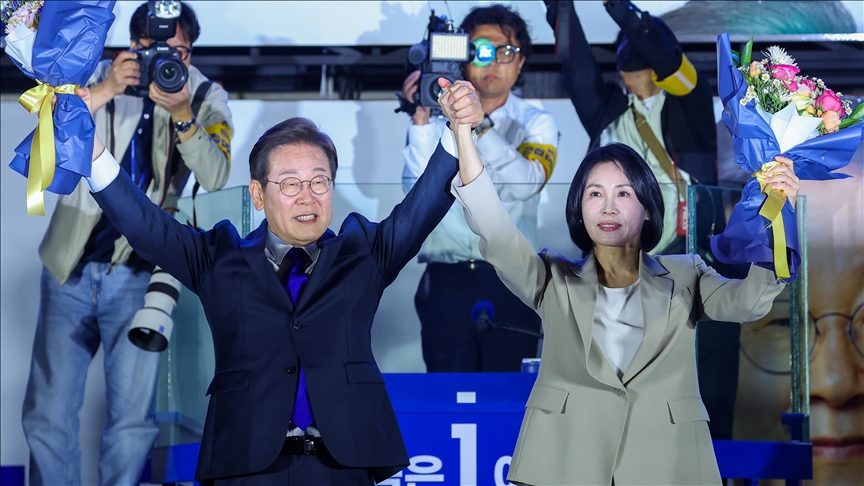
South Korea’s newly elected President Lee Jae-myung pledged on Wednesday to restore democratic values and revitalize the national economy, which he described as facing serious challenges due to global protectionist trends.
Lee’s victory in Tuesday’s snap election marks a significant political shift in Asia’s fourth-largest economy. The election followed the early departure of former President Yoon Suk Yeol, who left office three years into his term amid controversy over a failed attempt to impose martial law.
President Lee takes office at a time of deep political divisions and economic uncertainty. His administration is expected to address a range of complex issues, from restoring public trust in democratic institutions to navigating a shifting global trade landscape, including increasingly protectionist measures from key partners such as the United States.
“The Lee Jae-myung administration will pursue pragmatic, pro-market policies,” Lee said during his inauguration at the National Assembly. The location held symbolic meaning, as it was the site where he had once evaded martial law enforcement to participate in legislative proceedings.
Lee emphasized deregulation and innovation as core strategies for economic recovery and committed to resuming dialogue with North Korea while maintaining strong ties with the United States. “The best security is peace that doesn’t require conflict,” he said, referencing tensions on the Korean Peninsula.
Shortly after being formally confirmed by the National Election Commission, Lee assumed presidential duties, including receiving a briefing on national defense from top military leadership.
Lee secured 49.42% of the nearly 35 million votes cast, compared to 41.15% for his conservative opponent Kim Moon-soo. Voter turnout reached its highest level since 1997.
On his first day in office, Lee prioritized economic issues, particularly those affecting small businesses and households struggling with rising living costs. He also faces a key trade policy challenge: responding to import tariffs imposed by U.S. President Donald Trump, which have impacted major South Korean industries such as automotive and steel.
South Korean financial markets responded positively to Lee’s inauguration. The KOSPI index rose over 2%, reaching a 10-month high, with gains led by the financial sector and renewable energy stocks amid expectations of regulatory reforms and a greener energy policy.
To address the leadership vacuum, Lee nominated four-time lawmaker Kim Min-seok as prime minister. Kim had previously warned of the risk of martial law under Yoon, a prediction that gained attention following the failed decree.
Lee is expected to engage with the United States early in his presidency. According to analysts, negotiating a resolution to tariff-related tensions with President Trump will be among his top priorities.
U.S. Secretary of State Marco Rubio congratulated Lee on his victory and reaffirmed the strong alliance between the two countries, grounded in shared values and economic ties. A White House official stated that while the election was seen as free and fair, the U.S. remains concerned about foreign interference in democratic systems.
President Lee has indicated he will take a more measured approach to relations with China and North Korea, emphasizing economic cooperation while avoiding heightened confrontation over regional security issues such as the Taiwan Strait. However, he also affirmed the importance of South Korea’s partnerships with Japan and the United States, describing the U.S. alliance as central to the country’s foreign policy.