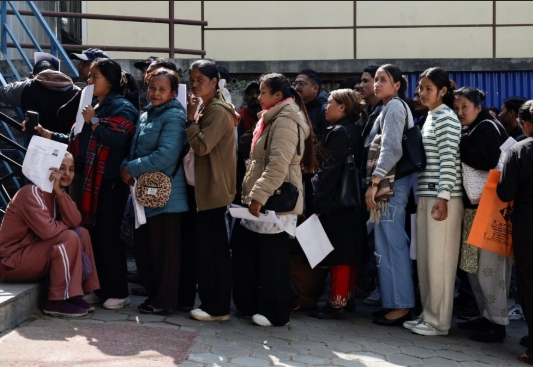
As Nepal prepares for a pivotal House of Representatives election on March 5, young Nepalis are increasingly skeptical that political promises will change their lives so much so that many are choosing to leave the country altogether in search of work.
At a training center in the Nepalese capital, 21-year-old Rahul Pariyar hooks a safety harness and practices basic construction skills that he hopes will help him land a job in the United Arab Emirates. “I’m not happy to leave my family,” he says, “but what choice do I have?” Wages abroad are roughly four times higher than what most young workers can earn in Nepal, making overseas work an almost inevitable choice for many.
The Rise of Unemployment, Fading Hope
The country’s youth unemployment rate stands at about 20.6%, the highest among all South and Southeast Asian nations, according to World Bank data. That stark figure underscores the failure of successive governments to generate enough jobs for young people entering the workforce.
As a result, about 3 million of Nepal’s 30 million citizens predominantly young adults are currently employed abroad, particularly in the Middle East. On average, around 1,500 Nepali youth leave the country each day in pursuit of foreign employment labour union data shows.
Villages across Nepal’s hinterland have felt the impact acutely, working-aged men and women are increasingly absent, leaving behind children and the elderly.
Election Pledges, Deep Skepticism
Political leaders acknowledge the urgency of the jobs crisis and have made employment a central theme in their campaigns ahead of the March poll.
- Rastriya Swatantra Party promises to create about 1.2 million jobs in a bid to reduce outward migration.
- Nepali Congress has pledged to generate 1.5 million jobs and halve the number of Nepalis leaving for work abroad over the next five years.
Yet for many young people, these pledges ring hollow. Widespread dissatisfaction with decades of intermittent political instability, governance failures and unmet promises has eroded confidence in the ability or willingness of established parties to deliver meaningful economic change.
Structural Challenges Beyond Politics
Economists and development experts point to deep-rooted structural issues that extend beyond campaign rhetoric:
- The manufacturing sector historically a key engine of jobs and growth has been shrinking, limiting opportunities for stable and well-paid work.
- Policy instability, weak infrastructure and skills mismatches have deterred private investment contributing to a sluggish domestic economy.
- Despite remittances amounting to nearly 25% of GDP, these inflows have done little to spur domestic job creation or structural transformation.
“A lot of youth here simply do not believe that elections will change their economic odds,” says one Kathmandu economist. “Promises are made every cycle but jobs don’t follow.”
The Human Cost of Migration
For workers like 31-year-old Ramesh Bahadur B.K. Nimaile, the decision to leave Nepal is shaped by financial pressures and family responsibilities. The eldest of six siblings and a former construction worker in Dubai, he is now heading back overseas to support his family after accumulating significant debt. “Will this election give me a job? No, right?” he asks. “Everything is expensive. What option do I have?”
Looking Forward
With Nepal’s economy still heavily reliant on agriculture which employs more than 60% of the population and a services sector that cannot absorb all job seekers, the youth exodus shows no sign of slowing.
As the March election draws closer, young voters are caught between political promises and the pressing need to forge livelihoods wherever that might take them. For many, the choice is clear: stay home and wait or leave now and work abroad.
________________________________________________________________________________________________________________