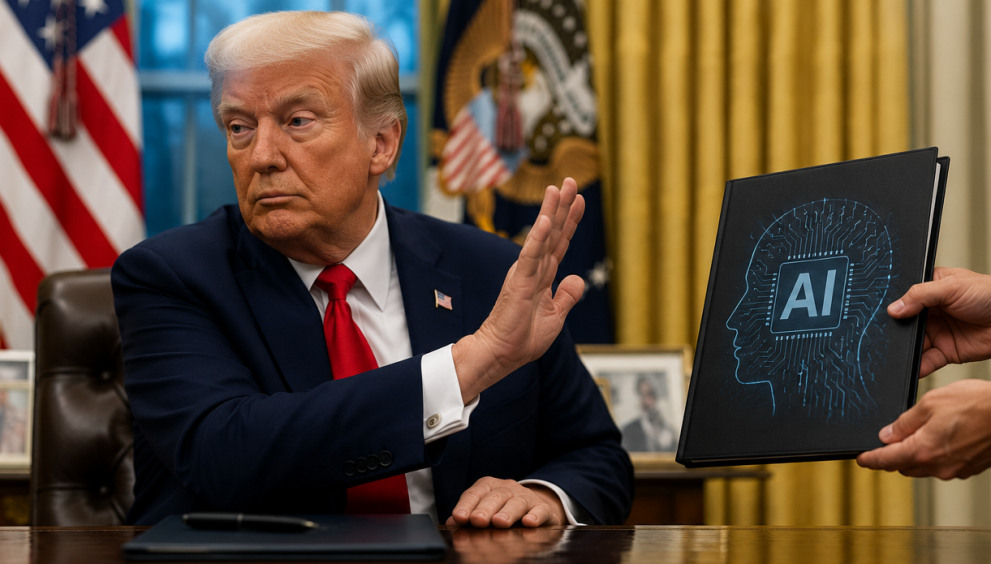
U.S. President Donald Trump abruptly canceled plans to sign a major executive order on artificial intelligence just hours before a scheduled White House ceremony, triggering fresh debate inside Washington and Silicon Valley over how aggressively the United States should regulate rapidly advancing AI technologies.
The decision came after growing concerns within the Trump administration and among major technology executives that the proposed order could slow innovation and weaken America’s competitive edge against China in the global AI race.
White House Ceremony Suddenly Scrapped
The signing ceremony had been scheduled to take place at the White House with several leading technology executives expected to attend, including representatives from major AI firms and cloud computing companies.
However, the event was canceled only hours before it was due to begin.
Speaking to reporters in the Oval Office, Trump said he postponed the order because he did not want to “get in the way” of U.S. leadership in artificial intelligence.
According to reports, the proposed executive order would have established a voluntary framework requiring AI companies to coordinate with the federal government before publicly releasing some advanced AI models. The framework reportedly focused on cybersecurity risks, national security concerns, and the monitoring of highly capable AI systems.
Concerns Over China and Innovation
Trump’s decision reflects broader fears within his administration that stricter oversight could slow American companies while China accelerates investment in AI development.
The president has repeatedly framed artificial intelligence as a strategic competition between Washington and Beijing, arguing that the United States must maintain technological dominance in areas including AI infrastructure, defense systems, and advanced computing.
“We’re leading China, we’re leading everybody,” Trump reportedly said while explaining his decision to delay the order.
The proposed order had reportedly triggered internal disagreements between officials focused on national security and those advocating minimal regulation to encourage innovation and private-sector growth.
Silicon Valley Pressure Intensified
Several reports indicated that prominent technology figures and industry lobbyists raised concerns about the executive order shortly before the planned signing.
According to media reports, some AI executives worried that even a voluntary government review system could eventually evolve into stricter federal regulation under future administrations.
The Washington Post reported that lobbying from Silicon Valley leaders and former Trump adviser David Sacks contributed to the last-minute reversal.
Executives reportedly feared that mandatory or semi-voluntary disclosure requirements could slow the release of new AI products and reduce the competitiveness of U.S. firms compared with rivals in China and other countries.
Some critics inside the technology industry also argued that excessive oversight could discourage investment in the rapidly expanding AI sector, which has become one of the most valuable parts of the global economy.
National Security Debate Intensifies
Despite opposition from parts of the tech industry, some administration officials and security experts had pushed for stronger oversight of advanced AI systems.
Reports indicated the draft order was partly influenced by concerns surrounding powerful new AI models and their potential impact on cybersecurity, misinformation, financial systems and critical infrastructure.
The debate intensified after disputes involving AI company Anthropic and concerns over advanced AI systems capable of autonomous decision-making and large-scale cyber operations.
Security officials have increasingly warned that highly advanced AI could be exploited for cyberattacks, automated propaganda campaigns, and military applications if not properly monitored.
At the same time, opponents of tighter controls argue that slowing U.S. AI development could hand strategic advantages to geopolitical rivals.
Trump’s Broader AI Agenda
Trump’s latest move highlights the complex and often contradictory direction of his administration’s AI policy.
Since returning to office, Trump has largely favored deregulation and rapid AI expansion. In January 2025, he signed Executive Order 14179 aimed at removing barriers to American AI leadership and reversing parts of the Biden administration’s AI safety framework.
His administration later introduced a broader national AI strategy focused on boosting domestic AI investment, expanding data center infrastructure, increasing exports of American AI technologies, and limiting state-level AI regulations.
Trump has also promoted AI education initiatives and encouraged partnerships between the federal government and major technology companies.
However, the latest reversal underscores growing divisions inside Republican circles and among Trump allies over how much oversight artificial intelligence should face.
Industry and Market Reaction
The postponement was widely viewed as positive news for several major technology companies, including firms involved in generative AI, cloud computing, and semiconductor production.
Investors interpreted the decision as a sign that the administration may continue favoring a lighter regulatory approach toward AI development.
Still, analysts warn that the absence of clear national standards could create uncertainty for companies attempting to balance innovation with safety concerns.
Experts also caution that global pressure for AI regulation is growing as governments worldwide grapple with the rapid expansion of advanced machine learning systems.
Uncertain Path Forward
White House officials have indicated that the executive order has not been permanently abandoned and could return in revised form after further negotiations.
For now, however, Trump’s decision has exposed deep tensions between national security priorities, economic competitiveness, and Silicon Valley’s push for minimal government interference.
The episode also signals that artificial intelligence policy is likely to remain one of the most politically sensitive and strategically important issues of Trump’s second presidency.
________________________________________________________________________________________________________________