

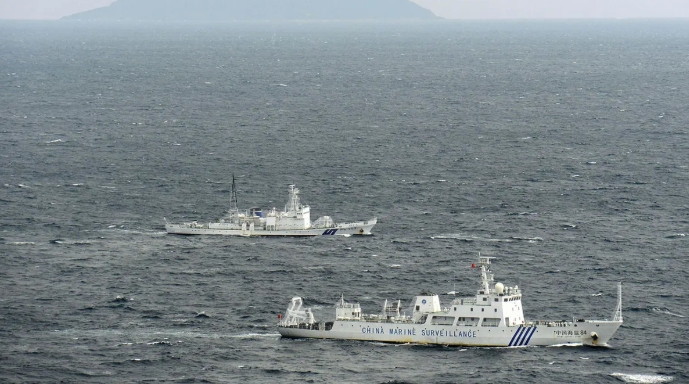
China has carried out military patrols in waters east of Taiwan following maritime security discussions between Japan and the Philippines, in the latest sign of rising tensions across the Indo-Pacific region.
The patrols, conducted by China’s People’s Liberation Army (PLA), came shortly after Tokyo and Manila held talks focused on strengthening maritime cooperation and regional security coordination amid growing concerns over Beijing’s expanding military presence in contested waters.
Chinese authorities said the operations were intended to safeguard national sovereignty and regional stability, while criticizing what Beijing described as attempts by outside powers to form security blocs targeting China.
China Expands Military Presence Near Taiwan
According to Chinese military statements, PLA naval and air forces conducted combat readiness patrols east of Taiwan, an area viewed as strategically important because it provides direct access to the western Pacific Ocean.
The Eastern Theater Command of the PLA said the exercises were aimed at testing operational capabilities and maintaining readiness in response to what it called “external interference” and separatist activity linked to Taiwan.
While Chinese military patrols around Taiwan have become increasingly frequent in recent years, the latest operation drew particular attention because it followed closely after maritime border and security talks involving Japan and the Philippines.
Taiwan’s defense ministry said it monitored Chinese aircraft and naval vessels operating around the island and deployed appropriate defensive responses. Officials in Taipei accused Beijing of escalating regional military pressure and destabilizing the security environment.
Japan and Philippines Deepen Maritime Cooperation
The patrols came after Japanese and Philippine officials discussed closer cooperation on maritime security, defense coordination, and regional territorial disputes.
Both countries have grown increasingly concerned about China’s activities in the East China Sea and South China Sea, where Beijing has expanded military deployments and asserted sweeping territorial claims.
Japan and the Philippines have strengthened security ties significantly in recent years as they seek greater coordination with the United States and other regional allies.
The discussions reportedly included issues related to maritime boundaries, coast guard cooperation, joint exercises, and protecting freedom of navigation in regional waters.
Analysts say the growing partnership reflects broader efforts among Indo-Pacific countries to counterbalance China’s expanding military influence.
Beijing Criticizes Regional Alliances
China has repeatedly warned against what it sees as efforts to create anti-China coalitions in Asia.
Chinese officials argue that increased military cooperation between Japan, the Philippines, the United States, and other regional partners threatens stability and risks escalating confrontation in disputed maritime areas.
Beijing also remains highly sensitive to any foreign activity involving Taiwan, which China claims as its territory under the “One China” principle.
Chinese authorities have accused Taiwan’s government of promoting separatism and have increased military pressure around the island since Taiwanese President Lai Ching-te took office earlier this year.
Taiwan rejects Beijing’s sovereignty claims and insists that the island’s future should be decided only by its people.
Strategic Importance of Waters East of Taiwan
The waters east of Taiwan hold major strategic value for both China and regional powers.
Military analysts note that control over the area would allow Chinese naval forces greater access to the Pacific Ocean beyond the so-called “first island chain,” a line of territories stretching from Japan through Taiwan and the Philippines.
The region is also critical for international shipping routes, military operations, and potential future conflicts involving Taiwan.
China’s increasing military activity east of Taiwan is viewed by many security experts as part of broader efforts to improve the PLA’s ability to operate farther from the Chinese mainland and project power across the western Pacific.
Regional Tensions Continue to Rise
Tensions across the Indo-Pacific have intensified steadily over the past several years due to territorial disputes, military modernization, and growing rivalry between China and the United States.
The South China Sea remains one of the world’s most contested regions, with overlapping territorial claims involving China, the Philippines, Vietnam, Malaysia, and other countries.
Meanwhile, Japan has expanded defense spending and strengthened security partnerships amid concerns about both Chinese and North Korean military activities.
The Philippines under President Ferdinand Marcos Jr. has also moved closer to Washington, granting the U.S. expanded military access to Philippine bases and participating in larger joint military exercises.
China has strongly criticized these developments, viewing them as attempts to contain its rise as a regional power.
Concerns Over Future Stability
Security experts warn that continued military activity and competing territorial claims increase the risk of accidents or confrontations in the region.
Although major powers have sought to avoid direct conflict, frequent naval patrols, military exercises, and air interceptions have heightened tensions and increased pressure on regional diplomacy.
Analysts say future stability in the Indo-Pacific will depend heavily on communication between regional powers, crisis management mechanisms, and efforts to prevent military incidents from escalating into broader confrontations.
For now, China’s latest patrols east of Taiwan underscore the growing strategic competition shaping Asia’s security landscape and the increasingly complex relationships among China, Taiwan, Japan, the Philippines, and the United States.
________________________________________________________________________________________________________________

