

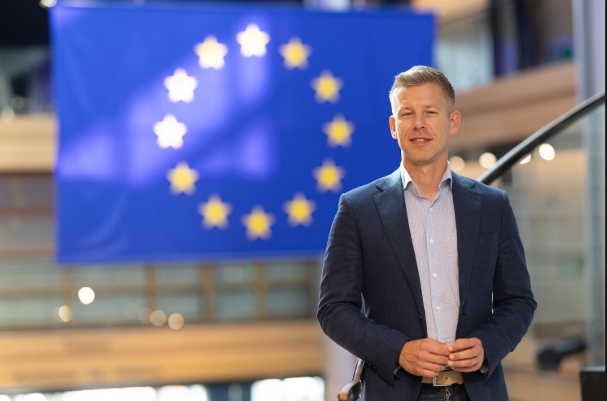
Hungarian opposition leader Peter Magyar has threatened legal action against President Tamás Sulyok if the head of state refuses to resign over allegations surrounding a controversial property deal linked to the president’s family, escalating political tensions in Hungary ahead of the 2026 parliamentary election.
Magyar, whose fast-rising Tisza Party has emerged as the strongest challenger to Prime Minister Viktor Orbán’s long-ruling Fidesz government, accused President Sulyok of failing to uphold the integrity of his office and warned that legal proceedings could follow if he remains in power.
The dispute marks the latest chapter in Hungary’s increasingly heated political environment as opposition forces seek to capitalize on public frustration over corruption allegations, inflation, and concerns about democratic standards under Orbán’s administration.
Magyar Intensifies Pressure on President
Speaking during a public appearance and in social media statements, Magyar claimed that President Sulyok had become politically compromised and should step down voluntarily.
According to Magyar, legal action could be initiated if the president refuses to resign, though he did not immediately provide detailed legal grounds for the potential proceedings.
The controversy centers on allegations related to property ownership and transactions reportedly involving members of Sulyok’s family. Hungarian opposition figures argue that the matter raises serious ethical and transparency concerns for the presidency.
Sulyok and government allies have rejected the accusations and dismissed opposition criticism as politically motivated attacks designed to weaken Hungary’s leadership before national elections.
Rising Political Force Challenges Orbán
Peter Magyar, a former insider linked to Hungary’s governing elite, has become one of the most significant political challengers to Orbán in years.
Magyar gained national prominence after publicly breaking with the government and accusing senior officials of corruption, abuse of power, and manipulation of state institutions. His anti-corruption messaging and calls for political reform have attracted growing public support, particularly among younger voters and urban middle-class Hungarians.
Recent opinion polls have shown Magyar’s Tisza Party narrowing the gap with Orbán’s Fidesz party, increasing pressure on the government ahead of the next election cycle.
Political analysts say Magyar’s rise represents one of the most serious threats Orbán has faced during his more than decade-long dominance of Hungarian politics.
Presidency Drawn Into Political Conflict
Hungary’s presidency is traditionally viewed as a largely ceremonial office, but the latest allegations have pulled President Sulyok directly into the country’s intensifying political battle.
Opposition politicians argue that the president should remain politically neutral and maintain high ethical standards due to the symbolic importance of the office.
Government supporters, however, accuse Magyar of attempting to undermine state institutions and create political instability through sensational accusations.
Fidesz officials have repeatedly described opposition claims as part of a coordinated campaign aimed at weakening Hungary’s conservative government and damaging public trust in national institutions.
Corruption and Transparency Remain Major Issues
Corruption allegations have remained a persistent issue in Hungarian politics in recent years.
The European Union has repeatedly expressed concerns about transparency, judicial independence, media freedom, and the use of EU funds under Orbán’s administration. Several EU funding packages to Hungary have been delayed or partially frozen due to rule-of-law disputes between Budapest and Brussels.
Magyar has sought to position himself as a reformist alternative promising stronger accountability, anti-corruption measures, and closer cooperation with European institutions.
Analysts say corruption-related controversies could become a central issue in the 2026 election campaign as economic pressures continue affecting Hungarian households.
Orbán Faces Growing Domestic Pressure
Prime Minister Viktor Orbán remains one of Europe’s longest-serving leaders and continues to maintain strong support among conservative and rural voters.
However, Hungary’s economy has faced mounting challenges, including inflation, slowing growth, and tensions with the European Union over sanctions, governance standards, and foreign policy.
Political observers note that Magyar’s emergence has altered the dynamics of Hungarian opposition politics by uniting previously fragmented anti-government voters around a single high-profile figure.
The government still controls significant political and institutional advantages, including strong influence over state media and local political networks, but analysts say the political environment has become increasingly competitive.
Uncertain Legal and Political Outcome
It remains unclear whether Magyar’s legal threats against President Sulyok will result in formal court proceedings or parliamentary action.
Hungary’s constitution provides significant protections for the presidency, and legal experts say any serious constitutional challenge would likely face major procedural hurdles.
Still, the confrontation underscores growing polarization in Hungarian politics as both the government and opposition prepare for what could become one of the country’s most consequential elections in years.
With public trust, corruption allegations, and democratic accountability increasingly dominating political debate, the clash between Magyar and Hungary’s presidency is likely to remain a major issue in the months ahead.
________________________________________________________________________________________________________________

