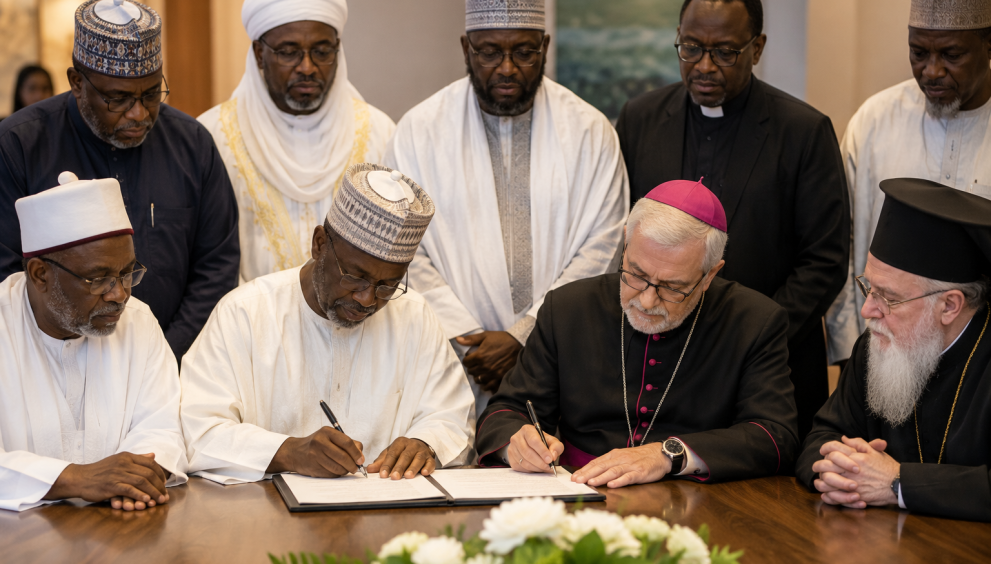
Interfaith Leaders Unite in Abuja
More than 50 Muslim and Christian leaders in Nigeria have signed a peace accord aimed at strengthening religious harmony and countering extremism. The initiative marks a major interfaith effort months after remarks by U.S. President Donald Trump drew global attention to religious violence in the country.
The agreement was signed in Abuja during a conference organized by the Saudi-based Muslim World League. It establishes a new interfaith council designed to promote dialogue, reduce sectarian tensions, and encourage cooperation between religious communities across Nigeria. Leaders from both faiths described the accord as a commitment to peaceful coexistence, national unity, and joint action against hate speech and radicalization.
Call for Peaceful Coexistence
Speaking at the ceremony, Mohammad Al-Issa, secretary-general of the Muslim World League, said extremism harms all communities regardless of religion. He urged greater collaboration among faith leaders to prevent violence and strengthen social trust.
Christian and Muslim clerics present at the event said the initiative aims to reduce suspicion between communities and create early mechanisms for resolving disputes before they escalate into conflict.
Background of Religious Tensions
The accord comes after months of heightened debate over religious security in Nigeria following Trump’s criticism of the Nigerian government over the killing of Christians by militant groups.
The Nigerian government has repeatedly rejected claims of state-backed persecution of Christians, insisting that insurgent violence affects both Muslims and Christians. Officials argue that the crisis reflects broader insecurity driven by armed groups rather than targeted religious policy.
Nigeria–U.S. Relations and Security Cooperation
Relations between Nigeria and the United States have fluctuated since Trump previously threatened aid cuts and possible military action over alleged anti-Christian violence.
However, a recent letter from Trump to President Bola Tinubu praised Nigeria’s efforts to address violence affecting Christian communities. The message signaled a warming of security cooperation between both countries, including expanded intelligence sharing and counterterrorism coordination.
Nigeria’s Security and Religious Landscape
Nigeria, Africa’s most populous country with more than 230 million people, is roughly evenly divided between a predominantly Muslim north and a largely Christian south.
The country continues to face major security challenges from Boko Haram, Islamic State West Africa Province (ISWAP), armed bandit groups, and recurring communal clashes. These overlapping conflicts have made religious and ethnic tensions a persistent national issue.
Political Context Ahead of 2027 Elections
Government representatives at the Abuja conference welcomed the peace accord as an important step toward strengthening national cohesion ahead of the January 2027 presidential election.
Religious representation is expected to remain a sensitive political issue. The initiative is particularly notable as President Tinubu’s ruling party continues to field a Muslim-Muslim presidential ticket, departing from Nigeria’s long-standing tradition of balancing major religious groups in national leadership.
Outlook for the Peace Initiative
Analysts say the success of the accord will depend on whether religious leaders can move beyond symbolism and implement practical measures such as local mediation, community outreach, and coordinated responses to extremist recruitment and inflammatory rhetoric.
Supporters believe sustained interfaith cooperation could help reduce tensions in conflict-prone regions and contribute to broader national stability.
________________________________________________________________________________________________________________