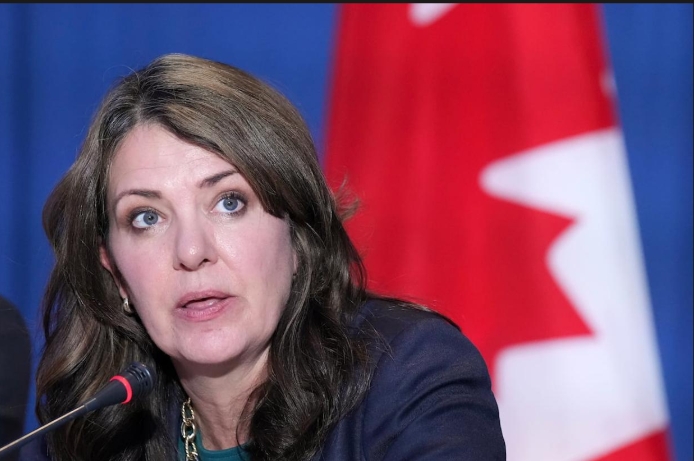
Alberta Premier Danielle Smith has rejected calls to restrict or tax the province’s oil and natural gas exports to the United States, warning that using energy as a weapon in the escalating Canada-U.S. trade dispute could cause severe economic damage to Alberta and other Canadian provinces.
Smith made the comments on Wednesday as tensions between Ottawa and Washington intensified following the collapse of recent trade negotiations and the introduction of new U.S. tariffs on Canadian goods. She described the trade conflict as “tragic, unjustified, and wholly unnecessary” and argued that Canada should focus on diplomacy rather than escalating the dispute through energy restrictions.
Smith Warns Against Energy Retaliation
The Alberta premier strongly opposed proposals to impose an export tax on oil shipped to the United States or to deliberately reduce energy supplies heading south.
Smith said such measures could trigger a stronger response from Washington, potentially including additional tariffs on Canadian oil, natural gas and refined petroleum products. She warned that the consequences would extend beyond Alberta because Ontario and Quebec rely heavily on energy products and refined fuels supplied through U.S.-Canada trade.
According to Smith, restricting exports could also undermine Alberta’s energy industry and put hundreds of thousands of jobs at risk. She argued that the United States could respond by sourcing more crude from other international suppliers, potentially weakening Canada’s position in the American energy market.
Oil Remains Central to Canada-U.S. Trade
Alberta is Canada’s largest oil-producing province and remains deeply integrated with the U.S. energy market.
Provincial figures cited by Global News show that Alberta’s oil exports to the United States were worth nearly C$111 billion in 2025, representing a substantial portion of the province’s approximately C$177 billion in total exports.
The scale of the trade relationship makes energy a potentially powerful bargaining tool, but it also creates risks for both sides. Canadian producers depend heavily on access to U.S. refineries, while American refineries, particularly those configured to process heavy Canadian crude, depend on Canadian supplies.
Smith’s position is that disrupting this system would hurt Canadian producers and consumers while potentially encouraging U.S. buyers to develop alternative sources of crude.
Growing Debate Over Canada’s Energy Leverage
Smith’s position has placed her at odds with some Canadian political figures who believe energy exports should be considered as part of Ottawa’s response to U.S. tariffs.
Former Alberta premier Jason Kenney has argued that Canada should not voluntarily remove its most significant economic leverage from negotiations with Washington. He said Alberta’s oil and gas resources could be used to put pressure on the United States and questioned why Canada would take energy off the negotiating table while the trade conflict is escalating.
Ontario Premier Doug Ford has also advocated using Canadian resources as leverage, although he and Smith remain aligned on the importance of expanding Canada’s internal energy infrastructure and markets. Ford has supported efforts to develop additional pipeline capacity connecting Alberta’s oil to refineries and markets in eastern Canada.
Saskatchewan Also Keeps Oil Off the Table
Smith is not alone in opposing energy export restrictions.
Saskatchewan Premier Scott Moe has also rejected proposals for export tariffs on the province’s oil and potash shipments to the United States. Instead, Saskatchewan announced a 50% levy on U.S. alcohol, while keeping major natural-resource exports outside its retaliatory measures.
The differing approaches among Canadian provinces highlight the broader debate over how Ottawa and provincial governments should respond to Washington while protecting industries that depend heavily on cross-border trade.
Ottawa Keeps Its Options Open
Canada’s federal government has not publicly ruled out using energy as part of its negotiating strategy.
Industry Minister Mélanie Joly declined to say whether Alberta’s energy exports could eventually be used as leverage, saying the federal government does not negotiate its strategy publicly. She maintained that Canada has several options available as it confronts the latest U.S. tariffs.
Meanwhile, Prime Minister Mark Carney’s government has announced counter-tariffs on a range of U.S. products and measures intended to provide relief to Canadian businesses and workers affected by the trade dispute.
Push for Greater Export Diversification
Despite opposing restrictions on U.S. exports, Smith has continued to support efforts to reduce Alberta’s dependence on the American market over the longer term.
Canada and Alberta announced plans in July for a new west-coast oil pipeline that would eventually provide additional access to Pacific markets, including potential customers in Asia. The proposed project is expected to have capacity of about 1 million barrels per day, with construction potentially beginning as early as 2027.
For Smith, expanding export routes offers a way to strengthen Canada’s negotiating position without deliberately disrupting existing energy supplies to the United States.
Economic Stakes Remain High
The dispute comes at a critical moment for Canada’s economy, with businesses facing uncertainty over tariffs, supply chains and cross-border demand.
Smith’s refusal to restrict Alberta’s oil exports reflects her belief that Canada’s strongest strategy is to preserve energy revenues, maintain market access and pursue diplomatic pressure rather than trigger a broader energy confrontation.
The debate is expected to continue as Ottawa and Washington navigate their deteriorating trade relationship, with Alberta’s vast energy resources remaining one of Canada’s most important economic assets and potentially one of its most powerful negotiating tools.
________________________________________________________________________________________________________________