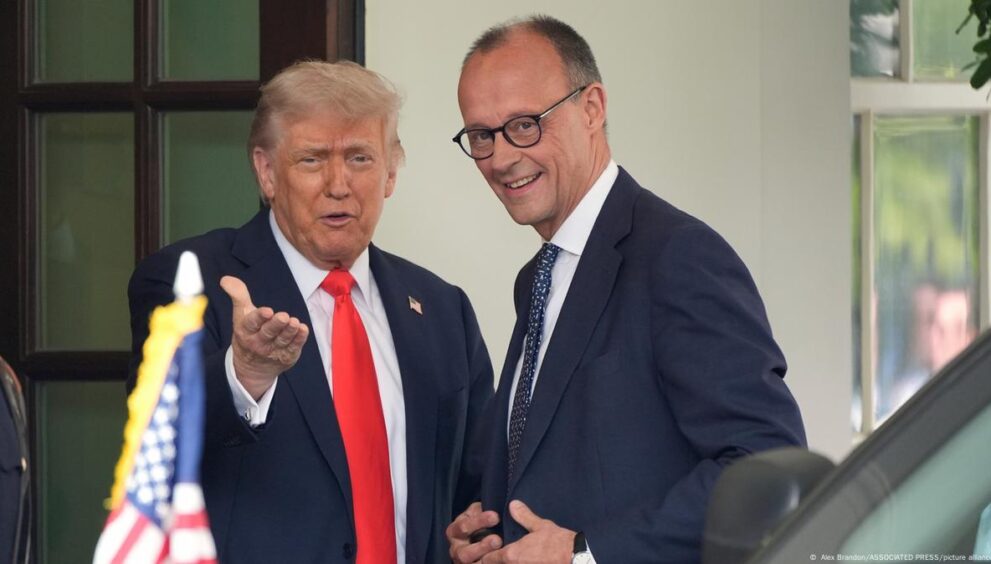
U.S. President Donald Trump and German Chancellor Friedrich Merz met amicably at the White House on Thursday, discussing issues including Ukraine, trade, and military presence. Unlike previous meetings between Trump and foreign leaders, this encounter lacked significant conflict or tension.
Trump described Merz as a strong representative of Germany, calling him “difficult” in a complimentary way. He affirmed that U.S. troops would remain stationed in Germany and welcomed Germany’s plans to increase its defence budget.
Merz, aiming for a constructive dialogue, criticised the Nord Stream 2 gas pipeline project from Russia to Germany—opposed by Trump—as a mistake. He also emphasised Germany’s willingness to enhance cooperation with the United States.
The meeting took place in the Oval Office, a venue known for more contentious discussions with other leaders such as Ukrainian President Volodymyr Zelenskyy and South African President Cyril Ramaphosa. However, Trump and Merz, both conservatives, appeared to share a positive rapport throughout their conversation. Merz began by thanking Trump for accommodating him at the Blair House, and Trump returned the courtesy. Merz also acknowledged U.S. efforts to liberate Germany during World War II.
After the meeting, Merz shared a photo of the two leaders playing golf in the Oval Office and told reporters that they had a good connection.
Despite the friendly tone, trade issues remained a sensitive topic. The U.S. and European Union are negotiating a trade deal critical to Germany’s export-driven economy. Trump stated he would accept either a trade agreement or tariffs. “We’ll end up hopefully with a trade deal,” he said. “I’m okay with the tariffs or we make a deal with the trade.”
Merz, who assumed office recently, said before the meeting that he did not expect major breakthroughs on tariffs, NATO, or the Ukraine conflict. Following the discussion, he expressed satisfaction with the outcome, describing a strong personal connection with Trump. He noted Trump’s emotional response to a gift—a copy of Merz’s grandfather’s German birth certificate from 1869.
Merz also confirmed that Trump accepted an invitation to visit Germany, with dates to be arranged.
Trump reiterated his call for NATO members to increase defence spending but hinted at some limitations for Germany given its World War II history. He also reassured that U.S. troops would remain stationed in Germany, countering previous threats to withdraw them.
Relations between the U.S. and several European countries have been strained in recent months, with the Trump administration’s involvement in European domestic politics and alignment with right-wing groups breaking with past diplomatic norms. Merz and his team reportedly sought advice on managing relations with Trump to avoid conflict.
The two leaders are scheduled to meet again later this month at the Group of Seven summit in Canada and at a NATO meeting, where Trump’s demands for increased defence spending among allies continue to cause tension.
Merz has supported Trump’s call for NATO members to eventually allocate 5% of their economic output to defence, a stance praised by U.S. Defence Secretary Pete Hegseth.
Although the meeting went smoothly, challenges remain. Merz had been publicly critical of Trump ahead of the 2024 U.S. election and recently defended Germany’s classification of the far-right Alternative für Deutschland (AfD) party as extremist, which had drawn criticism from U.S. politicians. This issue was not raised during the meeting and appears settled for now. Merz emphasised Germany’s status as a mature democracy with free speech protections and rejected outside criticism.
Jeff Rathke, a former U.S. diplomat and president of the American-German Institute at Johns Hopkins University, noted that Trump’s decision not to focus on differences was significant. “None of this means it will be smooth sailing for the next 3-1/2 years, but it’s about the best possible start to the relationship at the leadership level,” he said.