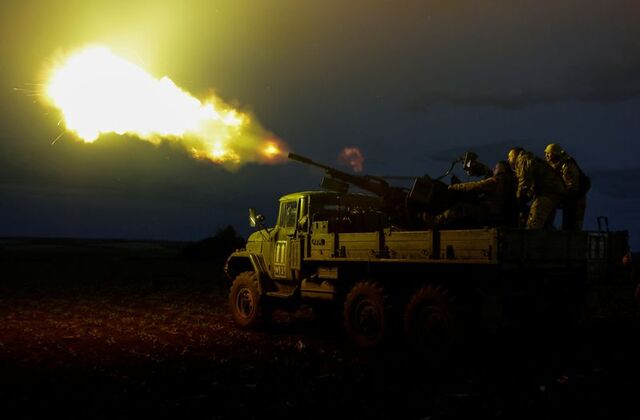
A senior German military official has stated that Europe has the ability to support Ukraine’s fight against Russia even if the United States were to completely stop its military assistance to Kyiv.
Major General Christian Freuding, responsible for coordinating Germany’s arms deliveries, explained that NATO’s European members, along with Canada, have already contributed military aid to Ukraine exceeding the estimated $20 billion provided by the U.S. last year. These allies cover about 60% of the total expenses borne by Western countries.
Freuding emphasized that the conflict in Ukraine is not only a war on the ground but also a struggle over European security. He said that if political determination exists, Europe can largely make up for any reduction in American support.
Currently, Ukraine continues to receive weapon shipments approved by former U.S. President Joe Biden, but there is uncertainty about whether the current U.S. administration will approve new deliveries or permit other countries to buy U.S. arms for Kyiv.
When asked how long the current supplies might last, Freuding responded that it depends on logistics and Ukraine’s consumption rate of weapons and ammunition, estimating that support could realistically continue through the summer.
He also noted the U.S. has a vested interest in strengthening its defense industry and cautiously predicted that buying American defense equipment for Ukraine will remain an option.
Regarding Russia’s military capabilities, Freuding warned that Moscow has a clear plan to rebuild and expand its forces, aiming to double its ground troops to 1.5 million by 2026. He said Russia is recruiting more personnel than needed to replace losses in Ukraine and is stockpiling ammunition.
Russia is also enhancing its military infrastructure, especially in the western region near Finland, a NATO member. A ceasefire in Ukraine might give Russia the opportunity to accelerate rearmament, potentially leading to a large-scale threat to NATO territory, which is currently projected around 2029.
Freuding acknowledged that any ceasefire could alter the security landscape. Russia, meanwhile, denies planning attacks on NATO and describes its actions in Ukraine as a “special military operation” aimed at defending itself from what it views as hostile Western aggression.
Germany has provided around 38 billion euros in military aid to Ukraine, making it the second-largest donor after the United States.
Freuding also mentioned that he is unaware of the previous U.S. administration approving arms deliveries to Ukraine financed by third parties. Despite Europe’s capability to compensate for much of the U.S. support, certain key elements would be difficult to replace, including U.S. intelligence, surveillance, reconnaissance data, advanced air defense systems like Patriot, and spare parts for American weaponry.
Replacing some of these intelligence capabilities will require further consideration if American support diminishes, as Ukraine heavily relies on U.S. data for air defense and targeting.